
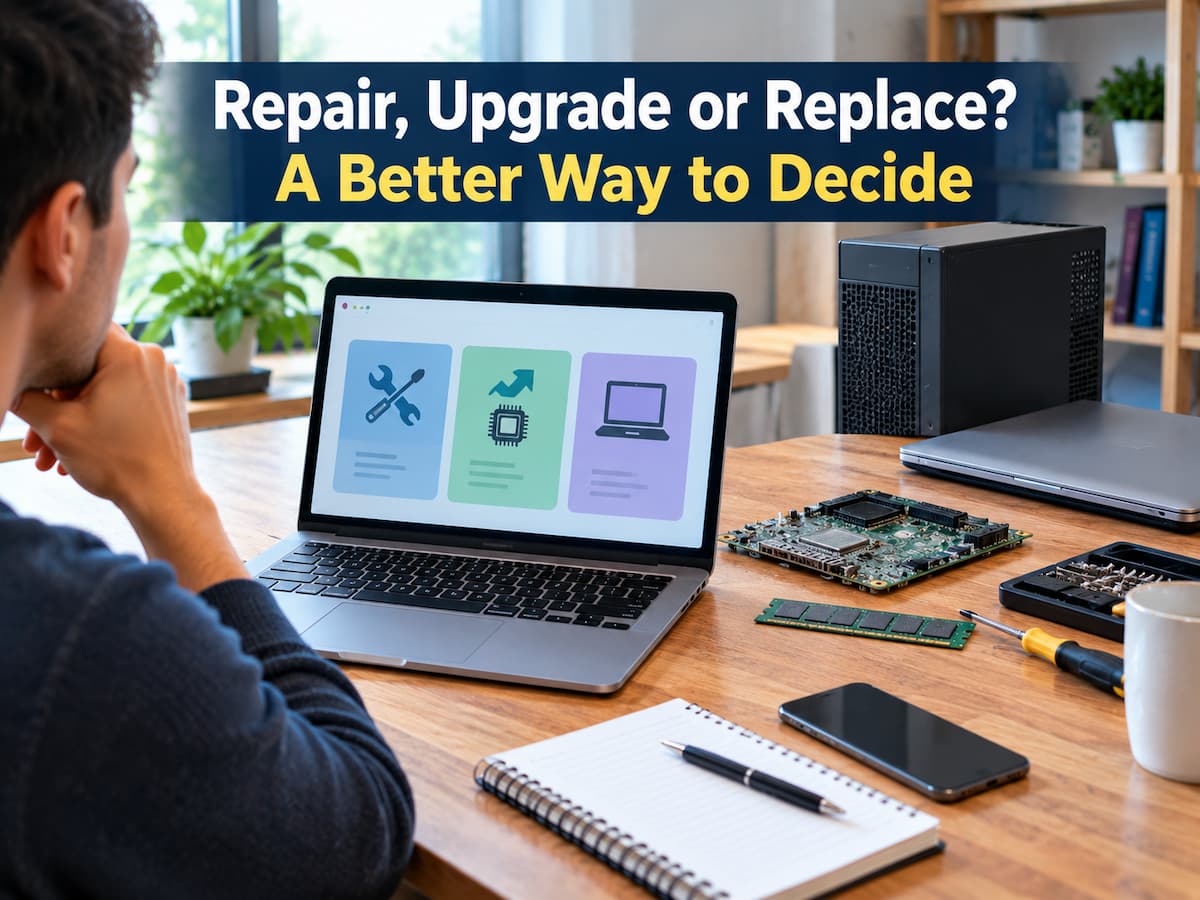
A broken or outdated item creates a deceptively simple question: should you fix it, improve it, or start over with something new? The cheapest option is not always the smartest one, and the newest option is rarely automatically the best. A repair may solve the immediate problem but leave an ageing system with several other weaknesses. An upgrade can extend useful life, yet sometimes costs enough that replacement makes more sense. The right decision depends on more than the price of the repair.
A better approach is to look at the item’s current condition, expected remaining life, performance, reliability, safety, and what you actually need from it. This applies to everything from appliances and computers to furniture, tools, home equipment, and other everyday purchases. The goal is not simply to spend less today. It is to choose the option that gives you the most sensible balance of cost, usefulness, reliability, and future value.
Start With the Problem, Not the Price
Before comparing repair quotes or browsing replacements, identify what is actually wrong. A single failed component is very different from an item that has several problems developing at the same time.
For example, a computer that has become slow because it has limited memory or an ageing storage drive may not need to be replaced. A targeted upgrade could restore much of its usefulness. On the other hand, if the machine has several failing components and cannot support the software you now need, spending money on one improvement may only postpone the larger problem.
The same reasoning applies outside technology. A chair with a damaged cushion may be worth repairing if its frame remains solid. A household appliance with one replaceable component may be a reasonable repair candidate. But repeated failures involving different parts can change the calculation.
The first question should therefore be: What problem am I trying to solve? Once that is clear, you can judge whether repair, upgrade, or replacement actually addresses it.
When Repair Usually Makes Sense
Repair tends to be attractive when the underlying item is still in good condition and the failure is limited to a specific component or problem. The repair becomes more compelling when the item is otherwise reliable, familiar to use, and difficult or expensive to replace with something comparable. A relatively inexpensive repair can preserve an item that already fits your space, workflow, or preferences without creating the additional cost and inconvenience of buying something new.
There is another advantage that is easy to overlook: repairing an existing item can prevent a premature replacement. If the item still performs its intended job well, replacing it simply because one part failed may create unnecessary expense and waste.
However, a low repair price should not automatically settle the decision. Consider the likely condition of the rest of the item. If one failure is followed by another shortly afterward, the total cost can become much higher than the first repair suggested.
The Repair Cost Is Only One Part of the Calculation
A useful comparison is to look at the total cost of keeping the current item, rather than focusing only on today’s repair bill.
Suppose an older appliance needs a €120 repair. A replacement costs €700. At first glance, repairing it seems obvious. But if the appliance is unreliable, consumes significantly more resources than a newer alternative, and has already required several repairs, the financial comparison becomes less straightforward.
You can think about the decision using four basic costs:
| Factor | Repair | Upgrade | Replace |
|---|---|---|---|
| Immediate spending | Usually lower | Moderate | Usually higher |
| Useful life gained | Often limited or moderate | Moderate to substantial | Potentially substantial |
| Performance improvement | Usually little | Often noticeable | Usually the largest |
| Risk of another failure | Depends on item age | Depends on remaining components | Usually lower initially |
| Disruption | Usually low | Moderate | Potentially higher |
| Best fit | Isolated problem | Existing item still capable | Item no longer meets needs |
These are not fixed rules. They are simply a way to make the comparison broader than the initial price.
When an Upgrade Is the Middle Ground
An upgrade makes sense when the core item is still suitable but one or two limitations are holding it back. This is particularly common with technology. Adding storage, increasing memory, improving connectivity, or replacing a worn component can sometimes make an otherwise useful device more practical. The same principle appears in other areas: improving lighting, replacing a worn component, adding useful accessories, or modifying an existing setup can solve a limitation without requiring a complete replacement.
The key is compatibility. An upgrade is only worthwhile if the rest of the system can take advantage of it. Spending money on one improved component does not necessarily make an old system equivalent to a newer one. There may be limitations involving compatibility, capacity, design, software support, physical condition, or other components.
Ask yourself whether the upgrade solves the actual reason you are dissatisfied. If the answer is yes and the underlying item remains dependable, upgrading can be an efficient middle option.
Age Changes the Decision
Age does not automatically mean something should be replaced. Plenty of older items continue to perform reliably, while newer products can develop problems sooner than expected. What age does change is the amount of remaining useful life you can reasonably expect.
An item near the beginning of its useful life with one repair problem may be a strong repair candidate. An older item with multiple failures requires a different calculation. You are not only paying for the current repair; you are accepting the possibility of additional spending later.
This is why the question should not be “How old is it?” by itself. A better question is “How much useful life can I reasonably expect after spending this money?”
That distinction prevents two common mistakes: replacing perfectly functional equipment simply because it is old and continuing to repair something that has become increasingly unreliable.
Consider Performance, Not Just Function
Something can technically work while no longer doing its job well. A computer may turn on but struggle with the programs you use. A tool may still operate but take much longer to complete routine work. A household item may function but consume excessive time because of slow performance or repeated adjustments.
This is where replacement can sometimes be justified even without a complete failure.
Think about the time the item saves or costs you. If a problem occurs every week, requires frequent troubleshooting, or makes routine work frustrating, its practical cost is greater than the repair invoice suggests.
An upgrade may be enough if performance is limited by one identifiable weakness. Replacement becomes more attractive when the limitations are fundamental and cannot be solved economically.
Reliability Has a Value of Its Own
Two options can have similar prices but very different levels of reliability.
Keeping an older item means accepting some uncertainty about future failures. Buying a replacement does not guarantee trouble-free operation, but it may reduce the immediate risk associated with an ageing item.
Reliability matters particularly when failure would create serious inconvenience. An inexpensive device used occasionally can tolerate more uncertainty than equipment that supports daily work. If a failure would interrupt an important routine, the value of dependable operation should be included in the decision.
This does not mean automatically replacing anything that has failed once. Instead, look for a pattern. One isolated failure is different from repeated breakdowns, recurring symptoms, or several ageing components showing problems.
Safety Should Override the Spreadsheet
Cost comparisons should not be used to justify keeping an item that presents a genuine safety concern. If an item has damaged wiring, structural deterioration, overheating, leaking, compromised protective components, or another potentially hazardous defect, professional assessment may be more appropriate than attempting to extend its life simply to save money.
The same principle applies when a repair requires specialised knowledge or creates a risk of injury or property damage. Saving money is not a successful outcome if the repair creates a larger problem.
For safety-critical equipment, the decision should be based on the manufacturer’s guidance, applicable safety requirements, and qualified professional advice where necessary.
Replacement Makes More Sense When the Item No Longer Fits Your Needs
Sometimes the problem is not damage at all. Your requirements have changed. A device may have been perfectly adequate when you bought it but become unsuitable as your workload grows. A piece of equipment may lack a feature that has become essential. Furniture may no longer suit a changed room. A tool may no longer handle the type of work you now perform.
In these cases, repairing the existing item may simply preserve a solution that no longer meets the need.
Replacement becomes more reasonable when the basic design, capacity, compatibility, or capabilities of the existing item are the limiting factors. An upgrade can work when the missing capability can be added economically. If it cannot, continuing to invest in the old item may only delay the inevitable.
A Simple Decision Framework
When the answer is unclear, score the three choices against the same questions.
- Repair: Does the repair solve the actual problem? Is the rest of the item in good condition? Is the expected remaining life reasonable for the money spent?
- Upgrade: Can the upgrade address the limitation without creating compatibility problems? Will the underlying item remain useful afterward? Is the improvement large enough to justify the cost?
- Replace: Does a new item solve several problems at once? Is the existing item unreliable or fundamentally outdated for your needs? Will replacement reduce repeated repair or maintenance costs?
A useful rule is to avoid comparing a repair against the full sticker price of a replacement without considering what each option delivers. The real comparison is money spent versus useful performance gained over the period you expect to keep the item.
Don’t Forget the Costs of Replacement
Buying something new involves more than its purchase price. There may be installation expenses, accessories, setup time, disposal costs, learning time, changes to your existing setup, or other secondary expenses. A replacement can also require you to change related equipment that previously worked together.
These costs do not always make replacement the wrong choice. They simply provide a more realistic comparison. Likewise, repair can have hidden costs. Time spent arranging service, transporting an item, waiting for parts, or dealing with repeated failures can matter. If an item is essential to your work or daily routine, downtime may be particularly inconvenient. The best decision therefore considers the entire transition, not just the number printed on a repair estimate or product listing.
A Practical Example: Three Different Outcomes
Imagine an older laptop that still handles everyday browsing and office work but has become slow. If the problem is primarily insufficient storage or memory and the machine supports a sensible upgrade, upgrading could extend its useful life without the cost of a new computer.
Now imagine the same laptop has a failing battery, a damaged charging port, ageing storage, and compatibility limitations with software you need. Repairing one component would not solve the broader problem. Replacement is likely to provide a more complete solution.
Finally, imagine a relatively recent laptop develops a single hardware fault while everything else works properly. A repair may be the most sensible choice, particularly if the repair is substantially cheaper than an equivalent replacement.
The item has not changed in these three examples. The condition, problem, and intended use have. That is why a fixed rule such as “replace after a certain number of years” is rarely enough.
The Better Question to Ask Before Spending Money
Instead of asking, “Which option is cheapest?” ask three questions:
- What will this choice cost me now?
- How long will it realistically remain useful?
- Will it solve the problem I actually have?
Those questions expose many poor decisions. A cheap repair that lasts only a short time may not be economical. An expensive upgrade that does not address the main limitation is wasted money. A replacement can be unnecessarily expensive if a simple repair restores everything you need.
There is also no requirement to choose the newest available option. If a repaired or upgraded item comfortably meets your needs, keeping it can be the more sensible decision.
Conclusion
Repair, upgrade, and replacement are not simply three price points. They are three different ways of solving a problem. Repair is often strongest when the problem is isolated and the item remains fundamentally sound. An upgrade works when the core system is still useful but has a specific limitation that can be improved. Replace becomes more attractive when reliability is declining, several problems are accumulating, safety is a concern, or the item no longer meets your requirements.
The smartest choice is the one that provides enough useful life and performance for the money you spend. Look beyond today’s repair bill, consider the condition of the whole item, account for downtime and secondary costs, and be honest about what you actually need. That approach makes the decision far more reliable than simply choosing whichever option has the lowest upfront price.
FAQs
1. Is repairing always cheaper than replacing?
Not necessarily. Repairs are usually cheaper upfront, but the cumulative cost of repeated repairs can end up being higher. The product’s condition and expected remaining lifespan are just as important as the current repair costs.
2. When is upgrading better than replacing?
Upgrading is a good option when an existing product’s basic functions still work and a specific defect can be fixed without compromising compatibility or reliability.
3. Should old products automatically be replaced?
Not necessarily. A product’s age alone does not determine whether it is still usable. Reliability, condition, performance, repair history, and current needs are better criteria for making a decision.
4. How do you compare the costs of repair versus replacement?
Compare the total cost of each option against the actual performance gains you expect. In addition to the initial price, consider potential extra repairs, installation, parts, downtime, and other related costs.
5. What if I can’t decide whether to repair or replace?
Request an accurate repair quote, identify the cause of the problem, assess the condition of the remaining parts, and compare this information with the cost and functionality of suitable replacements. If safety is a concern, seek advice from a qualified professional and do not let price be the only deciding factor.