
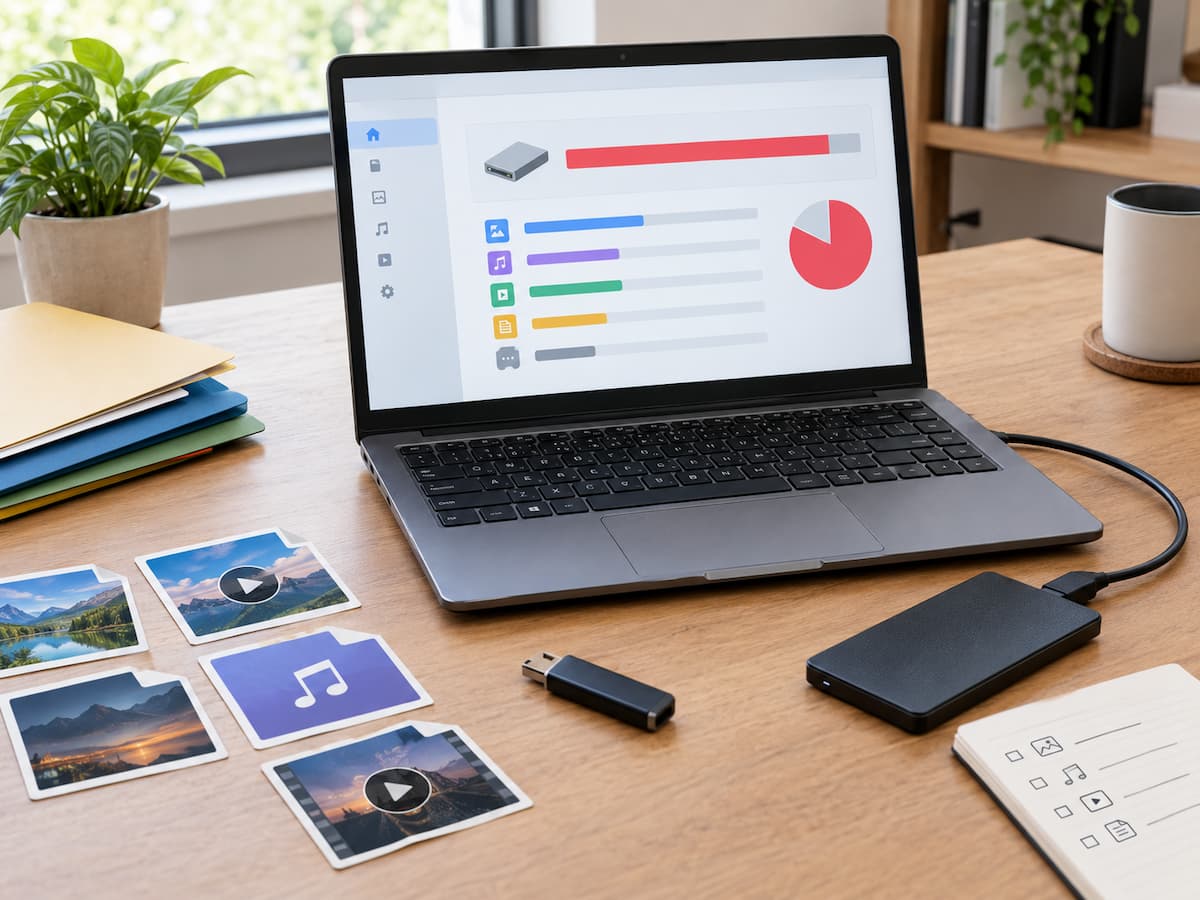
A larger drive isn’t always the answer. Years of downloads, duplicate files, obsolete installers, videos, backups, or unneeded software can cause the problem. Occasionally the drive is too small for the device’s use. This article explains what happens when storage space is tight, how to find what’s using it, which files are safe to erase, and when cleanup is no longer enough. By the end, you should know if your storage problem needs better organization, a different location, or more capacity.
Problem Is Bigger Than Low-Space Warning
Having a virtually full drive is different from running out of room for a photo. Current operating systems need storage for temporary files, caches, updates, application data, logs, and other data. When space is scarce, you can limit everyday operations. Microsoft says running out of storage might impair performance and cause Windows update issues.
Not all slow computers have storage issues. A poor processor, insufficient memory, overheating, background apps, malware, or an aging component can cause similar symptoms. Storage should be part of the diagnosis, not an afterthought.
One less visible expense is inconvenience. Every download involves a judgement about what to eliminate when the drive is nearly full. Big projects must be shifted. Manual prep may be needed for updates. You may skip useful apps since they take up space. At some point, storage becomes a resource you must constantly manage. A nearly full drive may not fail. Low capacity and hardware failure should be diagnosed only when useful.
How Full Is Too?
No percentage makes all storage drives “too full.” Operating systems, workloads, disc sizes, and usage patterns affect realistic limits. Even having an equal amount of empty capacity, a 256 GB system drive may fail sooner than a 2 TB drive.
Rather than fixating on a single percentage, concentrate on usable space and the symptoms your device is showing. If you often install apps, download huge files, edit media, or receive OS upgrades and the drive has little free space, pay attention.
| Storage condition | What it usually means | Recommended response |
|---|---|---|
| Plenty of free space | Normal operating room | Continue normal maintenance. |
| Free space is declining steadily. | Storage habits need attention. | Identify the most significant categories. |
| Very little free space | Updates and applications may become difficult. | Free space soon |
| Constant low-storage warnings | The current storage arrangement is inadequate. | Please clean up and reconsider the capacity. |
| Drive completely full. | Normal operation can become severely restricted. | Free safe space immediately |
Think of free storage as a working room rather than wasted capacity. The goal is to keep the drive nearly full. The goal is to avoid operating so close to its limit that ordinary tasks repeatedly run into a lack of space.
Why Low Storage Can Affect Performance
Storage and system performance are connected, but the relationship is often misunderstood. A drive being 90 percent full does not automatically make it 90 percent slower. The effect depends on the operating system, drive technology, workload, and how much free space remains available for normal operations. The practical problem appears when the system has little room for temporary data and other operations. Windows, for example, provides built-in storage management features and notes that low disk space can reduce performance.
Imagine editing a large photograph while the computer also needs temporary working space. If the system drive is already crowded with applications, downloads, and media files, the computer has less flexibility to create and manage additional data. The result may be slower or more frustrating than the same workload on a drive with comfortable free space.
There is another important distinction. If your device is slow because its processor or memory is inadequate, deleting 20 GB of old photographs will not suddenly transform it. Cleaning storage is useful only when storage is genuinely part of the problem. It should not be treated as a universal speed-up trick.
Updates Need Working Room Too
Operating-system updates are one of the clearest reasons not to let a system drive remain almost completely full. Updates may need temporary working space while files are downloaded, prepared, installed, and replaced. Microsoft specifically warns that low storage can cause difficulty installing Windows updates.
This creates an annoying cycle. A computer may still work normally, so the owner ignores storage warnings. Later, an update requires additional room. The update cannot complete, which leaves the owner searching for large files in a hurry. That rushed cleanup is more likely to result in deleting something important or moving files without creating a proper backup.
Apple also provides built-in storage management tools for Macs when the startup disk is nearly full, including recommendations for finding large categories of data and moving or removing files.
Find Out Where Your Storage Actually Went
The first cleanup mistake is opening a random folder and deleting whatever looks unnecessary. Start by finding out which categories are consuming the most space. This changes the task from guessing to investigating.
Windows users
Windows provides storage information under Settings, where usage can be broken into categories such as installed applications, temporary files, system and reserved storage, and other data. Microsoft also provides Cleanup recommendations and Storage Sense for managing unnecessary files.
Mac users
macOS provides storage information through System Settings and can show categories such as applications, documents, messages, and system data. Apple’s storage tools can help identify areas worth investigating before you start manually deleting files.
The objective is simple: identify the largest categories first. If videos consume 180 GB, deleting a collection of tiny temporary files is not going to solve the underlying capacity problem. When most of the drive is taken up by applications, removing unused software can lead to a much larger improvement.
The Large Files That Quietly Consume a Drive
Personal media is one of the easiest ways to fill storage without noticing. A single high-resolution video can consume more space than thousands of ordinary documents. Add several years of phone backups, exported videos, downloaded movies, raw photographs, game installations, and project files, and a drive can become crowded surprisingly quickly.
Downloads folders deserve special attention. People often download something for a single purpose and never return to remove it. Installers, compressed archives, duplicate photographs, exported documents, and old project versions can remain there for years. Do not automatically delete large files just because they are large. A 20 GB project archive may be more important than 20,000 small files. Look at the file’s purpose before deciding what happens to it.
| Storage category | Questions to ask |
|---|---|
| Videos | Do I still need the original files? |
| Photos | Are they backed up elsewhere? |
| Downloads | Was this file needed only temporarily? |
| Applications | Have I used this program recently? |
| Old projects | Can completed projects be archived? |
| Backups | Is this backup still needed and valid? |
Temporary Files, Caches, and Leftovers
Not everything consuming storage is a personal file that you deliberately saved. Applications and operating systems create temporary data, cached content, update files, logs, thumbnails, and other working files. Some of these files are useful for a while and then become unnecessary.
This is one reason built-in cleanup tools are preferable to manually deleting unfamiliar folders. Windows Storage Sense can automatically remove selected unnecessary temporary content, while Windows Cleanup recommendations can identify categories such as temporary files, large or unused files, and unused applications.
Macs have similar built-in storage management features. Apple explains that macOS can clear certain caches and logs when space is needed and provides recommendations for managing storage. Do not manually delete unfamiliar system folders simply because they are large. If you do not know what a file or folder does, investigate it before removing it.
Duplicates Can Become a Surprisingly Large Problem
Duplicate files are especially common when people move photographs, edit videos, or maintain multiple versions of documents. A project might exist in the original folder, an export folder, a backup folder, and a Downloads folder. Each copy may have a reasonable explanation, but together they can consume hundreds of gigabytes.
The solution is not to run a duplicate-finding tool and delete everything it discovers. Two files with the same name may not be identical, and two identical files may serve different purposes. For example, one copy may be part of a verified backup while another is your active working file.
A safer approach is to decide which location is the primary home for each type of data. Once that structure is clear, redundant copies become easier to identify. Important files should also have a proper backup rather than relying on an accidental second copy sitting somewhere on the same drive.
Why Randomly Deleting Files Is a Bad Strategy
Storage pressure creates urgency, and urgency leads to poor decisions. People often empty folders, remove old application directories, delete files with unfamiliar names, or uninstall software without checking whether they have stored important data inside.
A better cleanup follows a hierarchy. Start with files you know are unnecessary. Move files you want to keep but do not need every day. Uninstall applications you no longer use. Then review temporary files through the operating system’s built-in tools.
- Back up important files.
- Identify the largest storage categories.
- Remove files you definitely no longer need.
- Move archival data to appropriate storage.
- Uninstall unused applications.
- Use built-in cleanup tools for temporary data.
- Please verify the available space again.
- Monitor the drive over the following weeks.
This method is slower than deleting everything you recognize as old, but it dramatically reduces the chance of losing something important.
When External or Cloud Storage Makes More Sense
Sometimes the problem is not poor organization. You simply have more data than the internal drive was designed to hold. Large photo collections, video projects, music libraries, archives, and backups can eventually exceed the comfortable capacity of a small internal drive.
External storage is useful for files you want to keep but do not need to access every minute. Microsoft recommends moving large personal files to external storage when appropriate, while Apple similarly suggests moving media and other files to another storage device when more room is needed.
Cloud storage can serve a different purpose. It can provide access across devices and, depending on the service and configuration, reduce how much locally stored data is needed. Windows, for example, supports OneDrive Files On-Demand, which can keep smaller placeholders locally while the full files remain available through OneDrive.
Remember that synchronization is not automatically the same thing as a backup. If a file is deleted or changed in a synchronized location, that change may propagate. Important data deserves a backup strategy designed specifically for recovery.
When Cleaning Up Is No Longer Enough
Cleaning can solve a capacity problem, but it cannot change the physical size of a drive. If you repeatedly remove files only to become full again a few weeks later, your storage needs may have outgrown the current setup. This is especially obvious when the majority of the drive is occupied by data you genuinely need. If you have already removed unnecessary applications, old downloads, redundant files, and temporary data, but your normal work still leaves very little free space, another solution is needed.
| Situation | Better long-term response |
|---|---|
| The drive is full because of forgotten files. | Organize and clean up. |
| Large files are rarely needed locally. | Archive or move them. |
| The drive is consistently full with essential data. | Increase storage capacity. |
| The internal drive is aging or failing. | Back up and consider replacement. |
| The device cannot be upgraded. | Consider external storage or replacement |
The important distinction is between a storage management problem and a storage capacity problem. The first can often be fixed for free. The second may require additional hardware or a different storage strategy.
Build a Storage Habit Instead of Repeating Emergency Cleanups
A storage drive rarely becomes full because of one dramatic event. It usually happens through accumulation. A few downloads here, several videos there, another application, a backup, and an exported project can suddenly lead to the disappearance of hundreds of gigabytes.
A small monthly review can prevent such issues from becoming an emergency. Check the largest folders, review Downloads, remove applications you no longer use, and examine old projects. If you regularly create large media files, decide in advance where you will archive completed projects.
Windows Storage Sense can automate some cleanup tasks, and Microsoft’s storage tools can recommend files and applications for removal. Macs also include storage recommendations and optimization features that can reduce the amount of manual housekeeping required. Do not wait for a “disk full” warning to start managing storage. A routine review gives you time to make careful decisions and protect important files.
A Practical Storage Cleanup Checklist
If your storage drive is nearly full today, use this checklist in order rather than deleting random files.
- Check how much free space remains.
- Open the operating system’s storage-management screen.
- Identify the three largest categories.
- Review large personal files such as videos and old projects.
- Check the Downloads folder.
- Please remove any applications you genuinely no longer use.
- Please review duplicate files carefully.
- Use built-in temporary-file cleanup tools.
- Move archives and large media files to suitable storage.
- Empty the recycle bin or trash only after confirming its contents are no longer needed.
- Verify that important files are backed up.
- Please check the available space again after cleanup.
- Monitor how quickly the free space disappears afterward.
That final step is deceptively simple to overlook. If you free 50 GB today and then lose it again within a month, you still have the same problem. You need to determine what is generating the new data and whether your storage capacity matches your normal usage.
Conclusion
A nearly full storage drive has a cost that goes beyond losing the ability to save another file. Low free space can make everyday maintenance harder, interfere with updates, contribute to performance problems, and turn simple tasks into repeated storage emergencies. The encouraging news is that a full drive does not automatically mean you need a new computer or even a new storage device.
Start by finding out where the space is actually being used. Large videos, old downloads, unused applications, duplicate files, temporary data, and forgotten projects often account for much more storage than people realize. Remove anything you genuinely do not need, archive what you want to keep, and use built-in cleanup tools for system-managed data.
If the drive repeatedly fills despite careful management, that is useful information too. It may mean your storage needs have grown beyond the capacity of the current setup. At that point, additional internal storage, an external drive, cloud-based storage, or a broader device upgrade may make more sense. The important thing is to solve the actual storage problem rather than treating every low-space warning as a reason to replace the entire computer.
FAQs
1. Does an SSD slow down when it is nearly full?
A nearly full SSD can cause storage-related performance issues, though not all SSDs will slow down. The drive itself, the operating system, the workload, and the available space all influence performance. Crucially, insufficient free space can hinder system operations and updates. Freeing up space on a nearly full SSD is a good way to test the drive before concluding that it is faulty.
2. How much free space should I reserve?
There is no single recommended percentage of free space that applies to all devices. It is advisable to reserve some space for work, applications, temporary files, and operating system updates. If you frequently receive low-disk-space warnings or have to delete files before downloading updates, you likely have too little free space. Ideally, you should reserve enough usable space to avoid having to manage your storage on a daily basis.
3. Can a full hard drive damage my computer?
A full hard drive does not necessarily imply physical damage; however, insufficient free space can hinder operating system updates and task execution, potentially affecting system stability and availability. Furthermore, a full hard drive increases the risk of data loss due to hasty file deletion. If your drive is showing strange errors, losing files, or freezing repeatedly, check the drive’s status before assuming it is a capacity issue.
4. Should I delete temporary files to free up space?
Temporary files can be cleared out, but you should use your operating system’s built-in tools for these tasks whenever possible. Windows offers ‘Storage Sense’ and ‘Cleanup,’ while macOS provides storage management and optimization features. Do not manually delete system folders simply because they are large. Some files are required by applications or the operating system, whereas others are intentionally temporary.
5. Is it a sensible idea to migrate data to an external hard drive?
This can be a good option for internal hard drives containing many files that you rarely use—such as archives, photos, video projects, and other large files. However, external hard drives should not serve as the sole backup for important data. Do not rely exclusively on an external device to protect important data; ensure that you also back it up.