
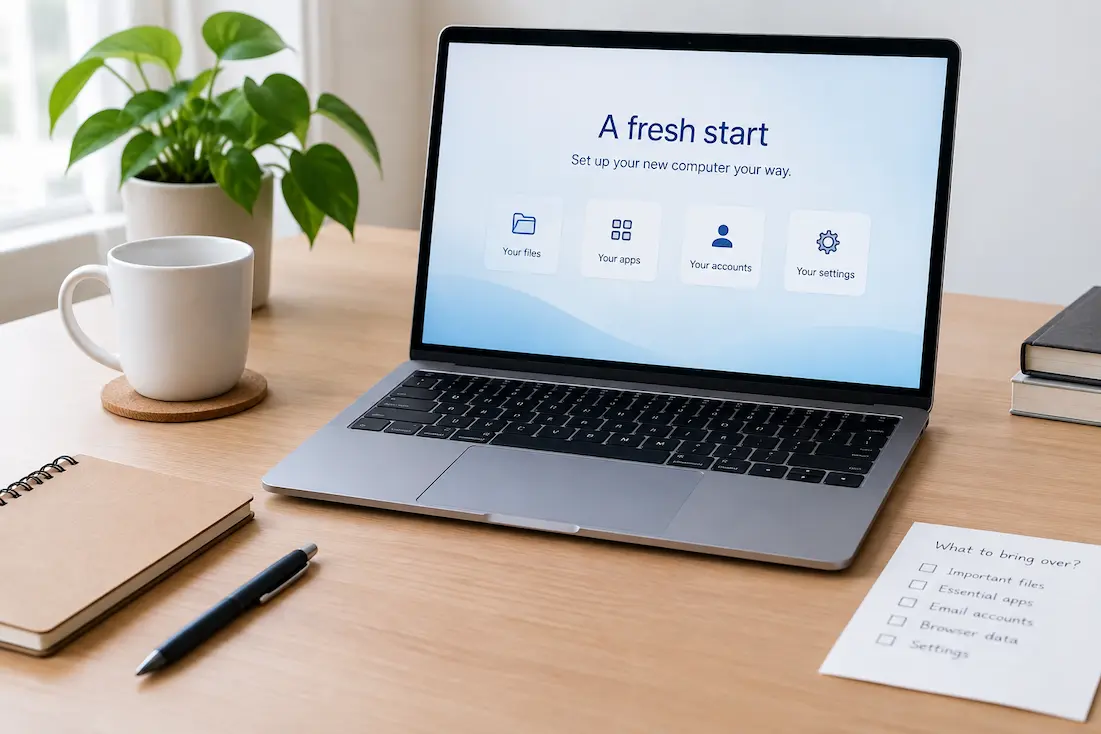
With your new computer, you have the freedom to choose which files to transfer, rather than automatically copying everything from your old machine as you might have done before. This is important because most computers eventually become cluttered with unnecessary files. Old installers, duplicate downloads, unused software, forgotten folders, browser extensions, and years of accumulated files can quickly make a new device feel outdated.
The most common mistake is viewing your new computer as a blank slate that needs to be filled immediately. A better approach is to treat it as a clean workspace. Transfer only the information you truly need. Rebuild the tools that align with your current habits. Leave ambiguous or redundant content on your old computer until you have a specific reason to move it.
This doesn’t mean starting from scratch entirely; it means carefully selecting which files deserve a place on your new computer.
Start with Your Current Workflow, Not Your Old Folder Structure
Before transferring files, consider how you typically use your computer. You might edit documents, manage photos, handle finances, study, edit media, communicate with clients, or simply browse the web. These activities determine what you need to set up again.
An old computer’s folder structure is rarely a carefully designed system; it is more often a record of events spanning years. Simply copying it over transfers old problems along with useful data. The right approach is to first identify which data, applications, accounts, and devices support your current work.
If you have done a lot of freelance work, you might have dozens of folders filled with unfinished projects. If only three of those projects remain relevant, there is no point in importing all those old folders into your new work environment.
Preserve Important Information before Simplifying
Decluttering during the migration process can be beneficial, but deleting information before understanding its value poses an unnecessary risk.
Before permanently parting with anything, ensure that all files are stored in a secure location. This is particularly important for documents that are difficult to replicate, personal photos, financial records, contracts, work materials, and other irreplaceable information.
The value of backups lies in their actual effectiveness. If possible, open a few files from the backup or otherwise verify that the information has been successfully preserved. Simply moving a folder to an external drive does not guarantee that all necessary files are actually there.
Once critical data is securely backed up, you have greater flexibility in deciding which data to transfer to your next computer.
Don’t Move The Downloads Folder Blindly
Downloads is one of the easiest places to accidentally carry years of digital clutter into a new machine.
A typical Downloads folder might contain software installers that have not been needed for years, duplicate PDFs, temporary attachments, images saved from websites, old forms, and documents that were supposed to be filed somewhere else. Moving everything preserves the clutter without necessarily preserving anything useful.
Instead, review the folder before the migration. Look for documents that are difficult to replace, recent files that still matter, and anything that belongs in your permanent filing system.
The Downloads Folder Audit Worksheet is useful here because it lets you classify individual files instead of making one large keep-or-delete decision.
Reinstall What You Need Instead Of Rebuilding Everything
A new computer does not need to contain every application that existed on the old one.
Start with software you genuinely use. Think about the tasks you perform every week rather than opening the old application list and installing everything that looks familiar. This usually produces a smaller and easier-to-maintain setup.
There is another advantage to reinstalling selectively: you get a chance to remove applications that became unnecessary over time. You may discover that a program was installed for a one-time task three years ago and has never been opened since.
For applications that contain important information, however, do not confuse reinstalling the program with recovering its data. Some programs store information locally, while others synchronize it through an account or require a separate export/import process.
Give Your Browser A Deliberate Reset
The browser is often the centre of a person’s everyday computer use, so it deserves more attention than simply installing it and signing in.
Check that important bookmarks, saved passwords, profiles, extensions, and other information you actually rely on are available. If you use multiple browser profiles for different purposes, make sure the relevant ones are present.
At the same time, avoid restoring years of unnecessary browser baggage just because it can be synchronized. A new computer is a good opportunity to remove extensions you no longer use and reconsider bookmarks that have not been relevant for years.
The goal is not to make the browser look identical to the old one. The goal is to make it useful from the first day.
Build A Simple Home For Your Files
A new computer can become disorganized quickly if every file is saved wherever it happens to be convenient.
You do not need dozens of folders. A small number of logical locations is often easier to maintain. For example, personal documents, work, projects, finances, photographs, and an archive may be enough for many people. The exact structure should reflect how you retrieve information rather than how someone else says a computer should be organized.
The Personal Digital Filing System Worksheet can help you design that structure before you begin moving large numbers of files.
The important part is not creating the perfect folder system on day one. It is creating a system that is obvious enough that you will actually use it.
Don’t Forget The Files Outside Your Main Folders
A migration checklist that includes only Documents, Pictures, and Desktop can still miss useful information.
Check the old computer for files stored in less obvious locations. This might include application-specific folders, project directories, exported files, shared folders, or material saved directly to the desktop. If you have used the computer for several years, your habits may have changed over time, leaving files in several different places.
You do not have to inspect every folder manually. Focus on applications and workflows that create information for you. If a particular program has been important to your work, find out where its projects or local data are stored before the old computer is retired.
This is especially important when the software is not cloud-based.
A New Computer Is Also A Good Time To Fix File Names
File organization is easier when files have names that tell you what they contain.
A new machine does not require you to rename thousands of old files before you can use it. Instead, establish a consistent naming habit for new files and rename important older files when you encounter them.
Dates can be particularly useful for documents that accumulate over time. A pattern such as 2026-09-09 – Electricity Bill – September makes files easier to sort and recognize than names such as bill-new-final.pdf.
The Digital File Naming Cheat Sheet provides practical naming patterns for receipts, warranties, contracts, projects, scans, and other common files without requiring an elaborate naming system.
Move Your Photos With More Care
Photographs are one area where “just copy the folder” can create confusion.
You may have originals in one location, edited versions somewhere else, screenshots mixed with personal photographs, and cloud copies that are not obvious from the computer’s folder structure. Moving everything without understanding those relationships can result in duplicates or unnecessary storage use.
Before migrating a large photo collection, determine where the original photographs actually live and whether they already exist somewhere else. Pay particular attention to photos stored only locally.
After the important originals are safe, you can deal with screenshots, duplicates, accidental images, and other clutter separately. The Photo Cleanup Checklist can be used for that cleanup rather than trying to make every photo decision while setting up the computer.
Test Your Accounts Before Retiring The Old Machine
Having access to your desktop doesn’t mean you have a fully set-up computer.
Log in to your most frequently used accounts and regularly check that key services are working correctly. Pay special attention to your primary email account, cloud storage, password manager, banking services, work platforms, and any accounts requiring additional security verification.
If you used your old computer as a trusted device for authentication, ensure you have set up alternative authentication methods before wiping or resetting it.
This is a detail easily overlooked, as everything seems fine until a service asks for authentication at an inconvenient moment.
Reconnect Only The Hardware You Actually Use
You may need to reconfigure printers, scanners, headphones, keyboards, mice, external hard drives, webcams, and other peripherals.
Make a list of the hardware you use daily. Then, test these devices on your new computer. Why spend an afternoon reconnecting devices you haven’t used in two years, simply because they were previously connected to your old computer?
If connecting a device requires manufacturer-supplied software or specific drivers, always download the latest version from the manufacturer’s official website rather than copying and installing it directly from your old computer.
Use The Old Computer As A Safety Net
One of the simplest and safest migration methods is not to wipe all data from your old computer immediately.
Keep your old computer powered on while performing daily tasks on your new device. Open old files, locate photos, log in to important services, launch necessary applications, and check frequently used peripherals.
You do not need to keep your old computer running continuously. The most important thing is to give yourself enough time to locate any messages you might have missed.
Even if data is lost, do not let the migration turn into a recovery process.
A Simple First-Week Approach
Instead of trying to finish everything in one sitting, divide the transition into manageable stages.
| Stage | Main Goal | What To Check |
|---|---|---|
| Before setup | Protect important information | Backups, photographs, documents, account access |
| First day | Make the computer usable | Accounts, browser, essential applications |
| First few days | Rebuild your routine | Workflows, files, printers, accessories |
| During normal use | Find missing details | Old documents, application data, forgotten settings |
| After confidence builds | Clean up | Unused files, applications, duplicates and clutter |
| Before retiring old computer | Final verification | Important data, accounts and recovery options |
This approach is deliberately less dramatic than trying to complete an entire digital life migration in one afternoon. It gives you time to notice what you actually need.
For a more structured transition, the New Computer Transition Checklist covers the major checks from preparation through the point where the old computer can safely be considered for retirement.
What Should Stay Behind?
The most useful question during a new-computer setup is not “How do I move everything?”
It is “What would I actually miss if this did not come with me?”
That question changes the migration from a copying exercise into a decision-making process. A ten-year-old installer probably does not deserve the same treatment as a family photograph. An abandoned project folder does not need to occupy the same space as an active client project. An unused browser extension does not need to follow you simply because synchronization makes it possible.
You are allowed to leave digital baggage behind.
The Fresh Start Should Stay Fresh
A cleaner new computer does not require an aggressive cleanup session or a perfect organizational system. It comes from making a few deliberate decisions before old habits automatically recreate themselves.
Protect important information first. Move the files and applications that support your current life. Verify accounts and application data. Test the new setup through ordinary use. Then clean up what remains when you have enough confidence to make those decisions safely.
The biggest advantage of a new computer is not that it has a new processor or a larger drive. It is that you get a rare chance to decide what your digital workspace should look like from the beginning. If you use that opportunity carefully, the new machine can stay simpler for much longer than the old one did.