
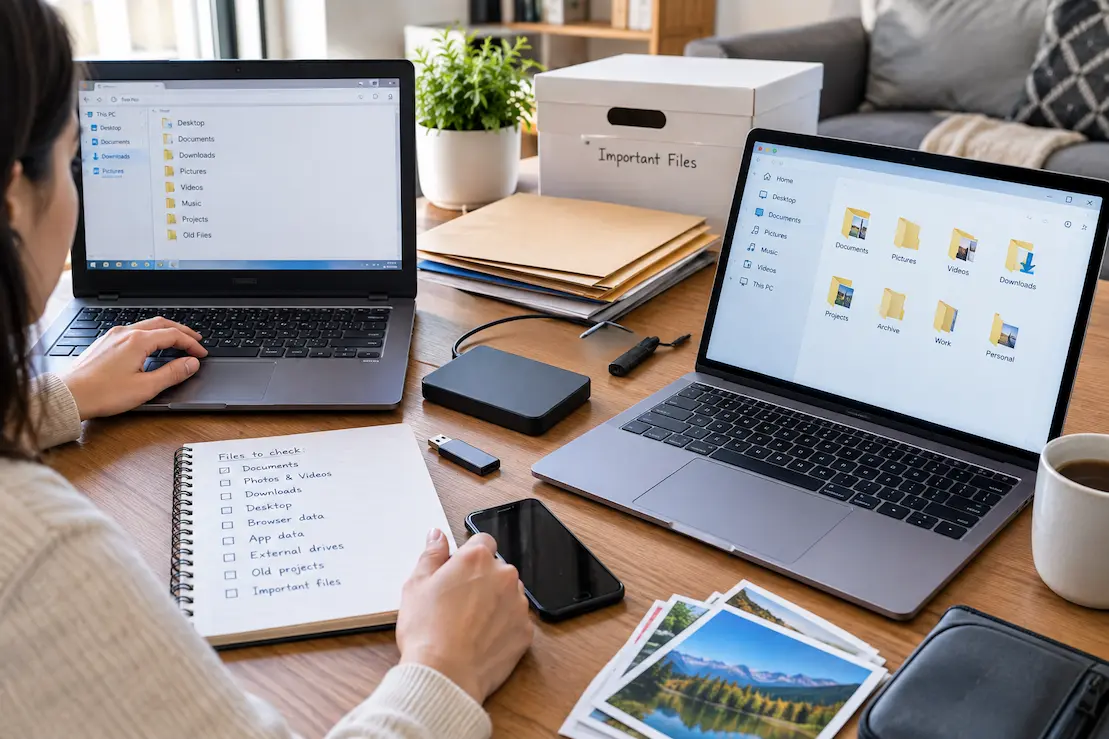
Moving to a new computer often looks easier than it really is. The obvious files usually make the trip: documents, photos, videos, and perhaps a few folders sitting on the desktop. The trouble starts later, when something small is needed and the old computer is already packed away, reset, sold, or unavailable.
The overlooked items are rarely the files people think about first. They can be browser exports, downloaded attachments, saved project material, application data, old scans, license information, or folders created by software without much explanation. A computer move is therefore not just a matter of copying the files you recognize. It is an exercise in finding the information that accumulated around your normal workflow.
Start With The Places You Actually Used
Before copying anything, think about where you normally saved things rather than where you believe you saved them. The Documents and Pictures folders are obvious starting points, but they are only part of the picture. Desktop files, Downloads, application-specific folders, external drives, cloud-sync folders, and folders created for individual projects can all contain useful material.
Downloads deserves particular attention because people often treat it as temporary storage. In reality, it can become a quiet archive of invoices, PDF manuals, exported reports, images, installers, forms, attachments, and files received from clients or colleagues. Some of these may have never been moved anywhere else. Deleting the folder after transferring only your “important documents” can therefore remove information you did not realize you still needed.
A useful approach is to make a list of storage locations before deciding what to move. Check the desktop, Documents, Downloads, Pictures, Videos, Music, cloud folders, external drives, and any obvious project folders. You do not need to copy every item right away. The first goal is simply to identify where information lives.
The Desktop Is More Important Than It Looks
Many people use the desktop as a temporary workspace and gradually turn it into a filing system. A spreadsheet might sit there for months, a PDF may contain information needed for a future task, and a folder could contain the last remaining copy of an old project.
The desktop can also contain shortcuts mixed with actual files, which makes a quick visual inspection misleading. A shortcut is not the same thing as the original file, while a folder sitting among shortcuts may contain several levels of useful material. Open folders and inspect what is actually stored there before deciding that the desktop is disposable.
Do not let the appearance of the desktop determine its importance. A cluttered desktop can contain nothing valuable, while a tidy one can contain the only copy of something important.
Downloads Can Hide Years Of Digital History
The Downloads folder deserves its own inspection because its contents often reflect how a computer has actually been used. It may contain files downloaded once and forgotten, but it may also hold documents that were never properly filed afterward.
Look for things such as receipts, contracts, warranty documents, tax-related records, exported account information, manuals, scanned forms, project deliverables, photographs, and files received through websites. Also look for attachments that you downloaded because you expected to use them later. Some may be replaceable, while others may be difficult or impossible to retrieve again.
This is one place where copying everything can be safer than making quick deletion decisions during the move. If storage space is not a problem, preserving the Downloads folder temporarily gives you time to review it after the new computer is working. You can then sort or delete items with less pressure.
A useful rule: If you cannot immediately explain what a file is, do not automatically delete it simply because it is old. Check its contents, date, source, and whether another copy exists first.
If your Downloads folder is particularly chaotic, the Downloads Folder Audit Worksheet on TuwenNews can help you review files individually instead of making decisions based only on filenames.
Look Beyond Ordinary Documents
Some of the easiest files to forget are in folders that people usually don’t think of as part of their personal data.
For example, a work project might have a folder containing source material, exported versions, reference images, temporary calculations, or supporting documents. A design application may use a separate project directory. A writing application might have drafts or backups. A developer may have local project folders that are completely separate from Documents. The important question is not whether a folder looks “official,” but whether it belongs to a workflow you still care about.
There is also a difference between personal files and application data. Some applications store settings, profiles, templates, saved sessions, or locally maintained information in locations that are not obvious from the application’s main interface. These should not be copied blindly, because some contain temporary or machine-specific data. But if a particular application is important to your work, identify what information actually needs to survive the move.
Check Old Projects Before Declaring Them Finished
Projects are particularly easy to underestimate. A folder named after a client, year, course, business idea, or personal project may contain material that has not been opened for years but could still matter later.
Instead of asking, “Have I used this recently?” ask a slightly better question: “Would losing this create a problem if I needed it again?”
That distinction catches files that are infrequently used but still valuable. Old contracts, completed work, receipts, source files, certificates, research material, and original photographs may have little day-to-day relevance but can be difficult to reconstruct.
Browser Data Can Be More Complicated Than Bookmarks
A computer move is not complete simply because browser bookmarks appear on the new machine. Your browser may also contain information associated with your normal workflow, including saved profiles, extensions, downloads, locally stored files, and other settings.
The exact migration process depends on the browser and the accounts or synchronization features being used. Instead of assuming everything will automatically appear, create a short list of what you actually rely on. Check whether your bookmarks are present, whether important passwords are available through your chosen password manager or account, and whether any browser-specific settings need to be recreated.
Be particularly careful with information that exists only on the old computer. If a password, bookmark, extension setting, or locally stored item is important, verify its availability before wiping the old machine. Do not assume that signing into the same account automatically recreates every piece of local data.
Photos Are Not Just The Images You See
Photo libraries can contain more than the photographs themselves. Screenshots, scanned documents, exported images, edited copies, videos, and folders from different devices can all mix.
The risk is especially high when photos have been copied between phones, computers, memory cards, and cloud services over several years. You may have multiple versions of the same image without realizing which one is the original. There may also be photographs stored outside the main library because they were downloaded, edited, or received as attachments.
Before moving a large photo collection, determine where the originals are and whether another copy exists. Do not start a massive cleanup simply because you are changing computers. Migration and decluttering are two different jobs, and combining them can make it much easier to delete something by mistake.
Check External Drives And Old Storage
The old computer may not contain everything you own digitally. External hard drives, USB drives, memory cards, network storage, and other storage devices can contain files that you stopped thinking about years ago.
This matters because a computer migration can create a false sense of completeness. You transfer the contents of the internal drive, start using the new computer, and later discover that an external drive contained old photographs or project material that was never included.
Make a simple inventory of connected and occasionally used storage devices. You do not necessarily need to move all their contents onto the new computer. The important thing is to know what exists, where it is stored, and whether there is another reliable copy of the information.
Files That Are Difficult To Replace Deserve Extra Attention
Not every file deserves the same migration priority. A downloaded application installer can often be obtained again. An old photograph, signed document, original project file, or personal record may not be replaceable.
A practical way to think about the move is to divide files into four groups:
| File situation | Sensible action |
|---|---|
| Easy to replace and not important | Leave behind or delete later |
| Useful but replaceable | Transfer if convenient |
| Important and difficult to replace | Transfer and verify carefully |
| Important with no confirmed second copy | Back up before doing anything else |
The last category deserves the most attention. If there is only one copy of something important, moving it to another computer is not a backup. A file can be accidentally overwritten, corrupted, or lost during a hardware problem. Ideally, important information should exist in more than one appropriate location.
Do Not Forget The Files You Created “Temporarily”
Temporary files have a habit of becoming permanent.
A spreadsheet created to calculate something, a text document used to draft an email, an exported report made for a meeting, or a folder created for a one-time task may still contain useful information. These files often have meaningless names such as New Document, Report2, Copy, or a date that no longer means anything.
You do not need to preserve every temporary file. Instead, look for files that contain information rather than files that merely represent a temporary step in a process. If the underlying information would be difficult to recreate, give it more attention.
This is also why filenames alone are a poor basis for migration decisions. Open unfamiliar files when necessary and examine their contents before deciding that they are worthless.
The Old Computer Should Stay Available For A While
One of the simplest ways to reduce migration mistakes is to avoid immediately wiping the old computer.
Once the new computer is configured, use it normally for several days or weeks if practical. Notice what you go looking for. The first time you think, “Where is that file?” is valuable evidence about something you missed during the transfer.
During this period, the old computer becomes a reference rather than your primary machine. When you find a missing file, make sure to transfer it properly and update your backup arrangements. Only consider resetting, selling, donating, recycling, or handing over the old computer after you are satisfied that the important information has made the transition.
The New Computer Transition Checklist on TuwenNews can be useful here because the migration is more than a file-copying exercise. It also covers accounts, applications, browser information, testing real tasks, backups, and the final verification before resetting the old machine.
A Better Final Check Before Wiping The Old Machine
Before the old computer leaves your control, perform a deliberately boring check. Boring is good here because rushing through familiar steps often causes migration mistakes.
Open the new computer and test the things you actually do, rather than just checking whether files appear in folders. Open several important documents, find a few older photographs, locate a project folder, check browser access, open important applications, and confirm that the files you care about are readable.
Then check the old computer for anything you might have overlooked. Pay particular attention to the desktop, Downloads, project folders, external storage, locally stored application material, and files that you recently created.
Only after this should you move toward the final reset.
A Simple “Would I Miss This?” Test
When you find an uncertain file, imagine that it disappears permanently today.
If the immediate reaction is, “That would be a problem,” preserve it.
If the reaction is, “I could get this again in five minutes,” it is probably less important.
If the reaction is, “I’m not sure,” investigate before deciding.
This sounds basic, but it changes the migration from a race to copy everything into a deliberate review. The goal is not to reproduce every byte of the old computer. The goal is to preserve the information and working environment that actually matter.
The Move Is Finished When The New Computer Works
A successful computer move should not be measured by how quickly the files were copied. It should be measured by whether you can carry out your normal work without repeatedly returning to the old machine.
That means checking more than Documents and Pictures. Look at Downloads, the desktop, old projects, browser information, application-related files, external storage, photo collections, and files that may be difficult to replace. Separate migration from cleanup where possible, and do not turn the last day with the old computer into a frantic deletion session.
Most importantly, do not reset an old computer simply because the obvious files have been transferred. Give yourself time to discover what you forgot. The files people miss are often not dramatic or unusual; they are the ordinary pieces of digital life that were stored somewhere convenient and then quietly forgotten.