
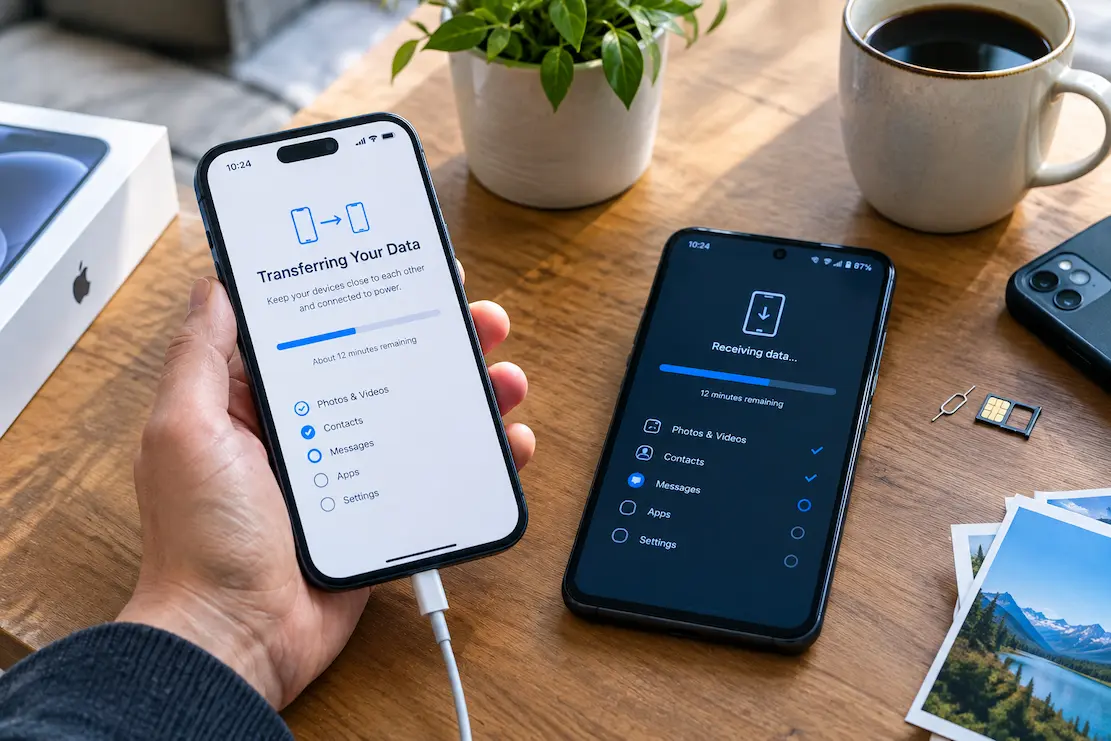
Switching phones seems much simpler than it actually is. The setup process takes a considerable amount of time, involving the transfer of contacts, photos, apps, and other essential data to the new phone. This creates the impression that the data from the old phone has been successfully copied. However, this is not always the case, as different services, apps, and account systems handle various types of information. Some data may be missing without it being immediately obvious. You might only discover the issue weeks later—for instance, when you need an old file, a verification code, a chat history, or a setting you use daily. It is best to treat your new phone as a device that requires verification, rather than simply assuming the setup is complete.
The Home Screen Is A Poor Test Of A Successful Transfer
The most common mistake is judging the success of the data transfer solely based on what you see after setup. If the new phone has the same apps, wallpapers, contacts, and recent photos as the old one, you might assume they are virtually identical. However, the appearance of the home screen does not tell you whether app data, local storage files, account connections, authentication methods, or older data have actually been migrated. Even if local storage data is lost, apps can often still be restored. Even if the old device is still being used for important security measures, you may still be able to log in to your accounts.
Do not try to compare the features of the two phones item by item. Instead, reflect on how you used your old phone. Consider what you created, saved, accessed, or relied upon—not just what is displayed on the screen. If you use your phone for work documents, receipts, scans, recordings, two-factor authentication, online banking, travel information, or important calls, you need to focus on those aspects rather than the layout of app icons. The question “Does the new phone look the same as the old one?” is pointless. What matters is: “Can the new phone do what I normally do?”
Photos Need More Than A Quick Gallery Check
Photos are often one of the first things people check, but even if your album looks full, that doesn’t mean it contains all your important photos. Photos can be stored in many different places on your phone—such as the main camera folder, screenshots, downloaded images, text message folders, editing apps, document scanning apps, and other app-specific locations. Furthermore, some older files might exist only on the old device and may not have been uploaded to your preferred cloud services. So, while seeing just the most recent photos might give you a sense of reassurance, that feeling may not be justified.
Choose a few photographs from different periods and open them on the new phone. Look for older family photographs, important screenshots, scanned documents, videos, and images that you know were stored locally. If you use cloud photo storage, make sure the account is the correct one and that the older material is actually accessible rather than simply assuming that the visible library represents everything. If the old phone contains a large collection that needs cleaning after the migration, the Photo Cleanup Checklist can be used separately. It is better to establish what survived the move before deciding what can safely be deleted.
Messages Can Hide Important Gaps
When data is lost, it can remain unnoticed for a long time. While recent conversations might appear correctly, older chats, attachments, voice messages, or app-specific messages may be unrecoverable. This is particularly significant because instant messaging apps often use their own backup or transfer methods rather than the phone’s standard backup system. Even installing the same messaging app on a new phone does not guarantee that your full history can be restored.
Take the time to consider which conversations you might need in the future. These chats could contain addresses, order numbers, work instructions, family details, photos, travel information, or other content that hasn’t been saved elsewhere. Don’t just check the most recent messages; open conversations from earlier periods as well. If you suspect important information is missing, check the app’s backup, transfer, export, or account recovery options while you still have your old phone.
Authentication Is One Of The Most Easily Overlooked Problems
You need to pay special attention to authentication apps, as they can cause problems exactly when you need them most. Even after transferring thousands of photos and dozens of apps, you might still find yourself unable to access your accounts because the authentication method remains linked to the old device. Simply installing the same authentication app on your new phone does not automatically restore access to the accounts you set up on your old device; the migration, backup, or data recovery process varies by service. Before discarding your old phone, make a list of important accounts that use two-factor authentication or other security methods compatible with your new device. Ensure your new phone can handle the required authentication or that you have other valid recovery methods in place. Pay special attention to your primary email account, as logging into it often allows you to recover access to many other services. This check is quick but can save you a lot of trouble after you’ve wiped the data from your old phone.
Test Your Passwords, Passkeys, and Account Access
Even if passwords appear to have transferred successfully, some important accounts may still require additional verification. If you use a password manager, ensure the necessary information is stored there when you log in on your new phone. If you use passkeys, verify that you can access your key accounts. Do not assume that an account appearing on the new device implies the login method is valid. Prioritize checking your primary email account, financial service accounts, cloud storage, and any other accounts that control access to sensitive information.
This is also a good time to identify accounts that rely on your old phone number, old device, or specific login methods. You don’t need to test every single account; focus on those that would be difficult to access—or regain access to—if you lost entry. It is far easier to resolve account issues while your old phone is still functional than after the device has been reset and passed on to someone else.
The Files Sitting In Downloads Are Easy To Forget
People often use their phones as temporary storage without even realizing it. Over time, invoices, receipts, PDFs, photos, forms, spreadsheets, documents, and files downloaded from websites or other apps accumulate in the Downloads folder. These files are easily overlooked because they do not always appear in the main gallery or the list of recently used apps. Consequently, even if important files are lost, the data transfer on your phone might still appear to have gone smoothly.
Open the file manager on the old phone and inspect Downloads and any other folders where you regularly saved documents. Pay particular attention to files that would be difficult to obtain again, such as receipts, contracts, warranty information, work documents, scanned forms, or personal records. You do not need to move every temporary file to the new phone. The important distinction is between information that can easily be downloaded again and information that would be genuinely difficult to replace. Once you know what matters, you can use the Downloads Folder Audit Worksheet to sort the remaining files instead of making random deletion decisions.
Installing An App Does Not Mean Its Data Came With It
One of the most confusing parts of a phone migration is that applications and application data are not necessarily the same thing. The application itself may be downloaded again from the relevant store while its settings, offline information, local projects, notes, recordings, or other stored content are handled separately. Some services restore information after you sign in, some rely on their own backup systems, and others may keep important information locally on the device.
You do not need to inspect every application individually. Instead, make a list of the applications that contain information you created or genuinely depend on. Check note-taking applications, document tools, recording applications, work-related software, messaging services, and anything else where losing local information would matter. If one of these applications appears empty on the new phone, stop before deleting anything from the old device and check whether the application provides its own transfer, backup, synchronization, or export option.
Banking And Payment Services Need A Separate Check
Financial applications can behave differently after a device change because security controls may recognize the new phone as a new device. The application icon may appear on the new phone, but additional registration, verification, or security confirmation may still be required before everything works normally. Payment wallets and other services connected to the phone can have their own setup requirements as well, so they should not be treated as ordinary applications that simply need to be opened once.
After setting up the new phone, test the financial services you regularly use and make sure you can access them normally. Check notifications, authentication, and any device-registration requirements that appear. You do not need to perform unnecessary transactions just to test an application; the objective is to confirm that the account and security process work as expected. If something requires the old phone for confirmation, resolve that issue before the old device is wiped.
Your Browser May Contain Years Of Useful Information
A browser can hold much more than a list of recently visited websites. Depending on how you use it, you may have bookmarks, saved credentials, reading lists, browser profiles, saved information, important open tabs, or other data that you rely on. Some of this information may synchronize automatically, while other items can depend on the particular browser account or settings used on the old device.
Rather than attempting to recreate every old browser tab, decide which information is genuinely worth carrying forward. Important bookmarks, work-related pages, saved references, and account information should be checked first. If the old browser contains hundreds of forgotten tabs, a new phone may actually be a useful opportunity to start with a cleaner setup. The important thing is to deliberately preserve useful information rather than accidentally losing it because it was assumed to be part of the standard phone transfer.
Contacts Can Look Complete While Still Being Poorly Organized
Contacts deserve a slightly different kind of check because the issue is not always missing names. If contacts are synchronized through more than one account, you may have contacts appearing from different sources, duplicated entries, or contacts saved to an account that you did not intend to use as the primary location. A contact list can therefore look perfectly normal while the underlying organization is different from what you expected.
Open several important contacts from different periods and check the information you actually use, including phone numbers, email addresses, notes, and other fields. If your contacts are synchronized with an account, verify that new changes are being saved to the expected location. One simple test is to create or edit a non-critical contact on the new phone and confirm that the change appears where you expect it to appear. That small check can reveal synchronization problems before you rely on the new device exclusively.
Some Small Settings Matter More Than People Expect
Not every missed item is a file or account. A new phone can also lose the small configuration choices that made the old device comfortable to use. Notification behavior, keyboard preferences, default applications, display settings, accessibility options, Bluetooth connections, and other preferences may require some manual attention. These details are easy to ignore during setup because they are not usually considered part of a “data transfer.”
The best approach is not to recreate every setting from the old phone immediately. Instead, notice the settings that affect your everyday routine. If typing feels different, notifications are too noisy, an important accessory does not connect, or a frequently used action now takes several extra steps, fix that specific problem. You may also discover that some old settings no longer make sense. A new phone is an opportunity to keep the useful parts of your old configuration without automatically carrying over years of accumulated clutter.
Accessories Can Make A New Phone Feel Incomplete
Wireless earbuds, watches, vehicles, speakers, keyboards, and other accessories are often forgotten until the first time you need them. The new phone may recognize an accessory’s name without actually having the same relationship with it that the old phone had. Some accessories also depend on companion applications, accounts, permissions, or additional configuration beyond ordinary Bluetooth pairing.
Make a short list of the accessories you use regularly and test them in the situations where you normally need them. If you use your phone in the car, for example, test the actual connection rather than merely checking whether the vehicle appears in the Bluetooth settings. The same applies to watches, headphones, and other everyday devices. These checks are quick, but they help expose problems that a standard transfer screen will never show.
Use The New Phone Normally Before Erasing The Old One
The most useful test is ordinary use. Instead of spending hours trying to predict every possible problem, use the new phone for the things you normally do. Make calls, send messages, open important files, take photographs, use your usual applications, access important accounts, connect accessories, and perform the tasks that form part of a normal day. Every real-world activity provides another opportunity to discover something that the initial setup process did not reveal.
This is why there is rarely a good reason to rush into resetting the old device immediately after the transfer. Keep it available while you gain confidence in the new phone. If you discover a missing file or account problem, you still have the original device available as a reference or source. The New Device Transition Planner provides a structured way to work through the before, during, and after stages if you want to make this process more deliberate.
The Final Check Should Focus On Irreplaceable Information
Before the old phone is finally reset, take one last look specifically for information that would be difficult to recreate. This includes important photographs and videos, locally stored documents, authentication methods, application-specific data, old conversations, recordings, account access, and anything else that exists only on the old device. You do not need to preserve every insignificant download or forgotten screenshot. The objective is to identify the information where a mistake would actually matter.
A useful question is: “If this disappeared tomorrow, would I know where to get it again?” If the answer is no, give that item additional attention before wiping the old phone. If the answer is yes, you can usually deal with it later. This simple distinction keeps the migration from becoming an endless attempt to duplicate every piece of digital clutter accumulated over the years.
Before You Reset The Old Phone
| Area | What To Verify | Why It Matters |
|---|---|---|
| Photos | Older photos, videos, screenshots and scans | Some may have been stored locally |
| Messages | Important older conversations and attachments | App-specific backups may be separate |
| Files | Downloads and locally stored documents | Important files are easy to overlook |
| Authentication | Two-factor codes and recovery methods | Losing access can lock you out |
| Passwords | Password manager and important accounts | Sign-in may require additional verification |
| Applications | Apps containing personal or work data | Installing the app may not restore its data |
| Contacts | Important contacts and synchronization | Multiple accounts can create unexpected gaps |
| Financial apps | Access and security verification | New devices may require re-registration |
| Accessories | Earbuds, watches, car, speakers and others | Pairing may not transfer automatically |
| Old device | Backup verified before reset | Erasure is difficult to undo |
The new phone does not need to be an exact copy of the old one to be a successful replacement. In fact, carrying everything over without reviewing it can simply move years of digital clutter onto another device. What matters is making sure the information and access you genuinely depend on have made the transition safely.
Once the important areas have been checked and the new phone has survived normal day-to-day use, the old device becomes much easier to deal with. At that point, you can make a separate decision about whether to keep it, sell it, give it to someone else, recycle it, or reset it. If you need help with that stage, the Old Device Handover Checklist provides a separate set of checks for preparing the device before it leaves your possession.
Frequently Asked Questions
Should I keep my old phone after setting up my new one?
Yes, it is best to keep your old phone—at least until you are using your new phone regularly and are certain that all your accounts and important data are working correctly. Your old phone serves as a useful backup in case you lose files, encounter authentication issues, or notice data problems with certain apps. If your old phone still holds original copies of important files, it is not a good idea to simply delete them.
Is everything on my phone backed up?
Not always. Backups protect a lot of important data, but different services and apps may handle data differently. You may need to double-check the status of local files, authentication apps, text messages, and data from specific apps. For safety’s sake, verify the information that matters to you; do not assume that a full backup means every single piece of data has been saved.
What should I check first after getting a new phone?
Start by backing up items that are difficult to replace, such as important photos, documents, text messages, passwords, authentication methods, and app data. Next, check your most frequently used accounts and services. Once you have verified these areas, you can take your time adjusting settings, removing apps, and connecting accessories.
When can I use my old phone again?
It is best not to restart use immediately after the data transfer. Wait until the new phone has been running smoothly for a while and you have verified all important information before starting up again. Before you do, ensure you have backed up everything you wish to keep and confirmed that your important accounts no longer rely on the old device. Once you have performed this final check, you can follow the appropriate steps to restart and transfer data from your old phone.
Do I need to transfer everything from my old phone to my new one?
Not necessarily. Once you have your new device, you can remove old apps, unnecessary downloads, forgotten accounts, and other unwanted files. Instead of backing up everything on your old phone, you can choose to keep only the data and features you actually need. By selectively transferring data, you can end up with a device that is cleaner and easier to maintain.