
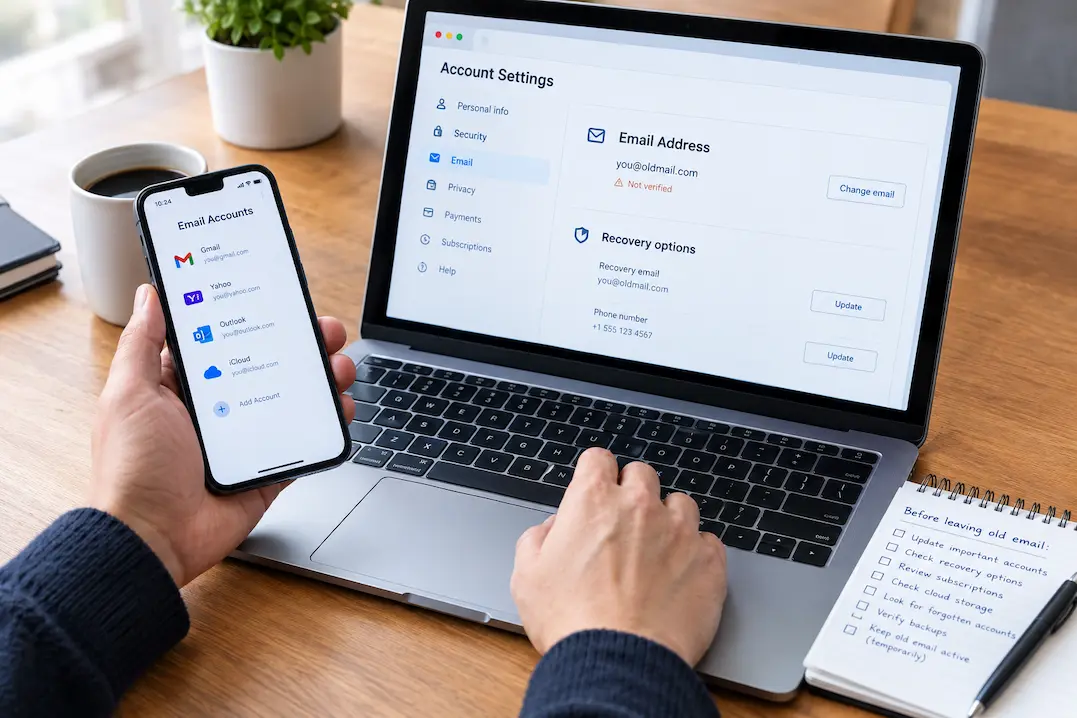
An old email address can remain connected to your digital life long after you stop using it regularly. It may be attached to shopping accounts, subscriptions, cloud storage, social platforms, banking services, work accounts, newsletters, recovery options, and websites you joined years ago and barely remember.
The difficult part is not creating a new email address. It is finding everywhere the old one still matters.
If the old address is eventually closed, abandoned, or simply becomes inaccessible, forgotten account connections can turn into a much bigger problem. Password resets may go to the wrong inbox, security alerts may never reach you, and an account you still need could become difficult to recover. A careful transition is therefore less about changing an email address everywhere in one afternoon and more about finding the accounts that actually depend on it.
Start With The Accounts That Could Lock You Out
Not every account needs the same level of attention.
A newsletter subscription is inconvenient if it continues using an old address. An account used to recover other accounts is much more important. The first part of the transition should therefore focus on accounts where losing access to the old email could affect your ability to sign in or recover access later.
Start with accounts involving:
- Password recovery
- Two-step verification or security notifications
- Financial services
- Cloud storage
- Important work or professional services
- Government or other essential services
- Primary shopping accounts
- Password managers
- Your main social or communication accounts
- Services containing irreplaceable personal information
The goal is to protect the connections between accounts, not merely replace an email address for cosmetic reasons.
Think In Terms Of Dependencies
Suppose an old email address is the recovery address for your primary cloud account, and that cloud account contains your important files. Changing the cloud account’s contact email may be more important than updating an old shopping account you rarely use.
This is why a simple alphabetical list of websites is not always the best starting point.
Ask instead:
“If I lost access to this old email tomorrow, which accounts would become harder to recover?”
Those accounts deserve attention first.
Your Password Manager Can Reveal A Lot
If you use a password manager, it can be one of the most useful places to start your account inventory.
Search for the old email address, if your password manager stores usernames alongside saved passwords. You may discover accounts that you completely forgot about.
Do not assume that every saved login is still active. Some may be obsolete, duplicated, or associated with services you no longer use. The purpose of the search is to build a list for review, not to update every old entry automatically.
As you go through the list, separate accounts into three simple groups:
| Account situation | Sensible action |
|---|---|
| Important and still used | Update the email address and verify access |
| Important but rarely used | Update and confirm recovery options |
| No longer needed | Close or remove the account if appropriate |
| Unsure whether it is still active | Investigate before making a decision |
Do not delete an old login simply because you no longer remember using the service. First determine whether it contains information, purchases, subscriptions, files, licenses, or another account relationship that you may still need.
Your Main Email Account Deserves Special Attention
If you are leaving an old email address that has been your primary address for years, it may have become part of the recovery chain for other services.
Think about what happens if you forget a password six months after closing the old mailbox.
If the password-reset message goes to an address you no longer control, the problem may not be solved simply by remembering your username and password. Some services may offer other recovery methods, but you should not depend on being able to use them later.
Before leaving the old address, review the recovery information on your important accounts. Where appropriate, add your new email address and confirm any other recovery methods you actually control.
Do not make changes based on a generic checklist alone. Each service has its own account and recovery process, so follow the provider’s current instructions for changing account information.
Cloud Storage Can Hide An Important Connection
Cloud storage deserves a separate check because it may be tied to both your files and your identity.
Review services where you store documents, photographs, backups, projects, or other important material. Confirm that you can sign in using your current credentials and that the account’s recovery information is up to date.
Also check whether the old email address is used for notifications rather than the actual login. These can be easy to overlook because the service continues working normally until an important security message is sent.
If the account is shared with family members, colleagues, or collaborators, consider whether changing the email address affects invitations, ownership, recovery, or administrative access.
The important thing is to avoid assuming that “my files are in the cloud” means the transition is automatically safe.
Shopping Accounts Are Worth Reviewing
Online shopping accounts can accumulate more information than people realize.
An old account may contain order histories, receipts, warranty information, saved addresses, subscriptions, digital purchases, or records of products you may need to reference later.
You do not necessarily need to preserve every old shopping account. But before abandoning the old email address, identify the retailers and services you still use.
For accounts you intend to keep, update the email address and confirm that you can still sign in. If an account contains important purchase records, consider whether you need to retain those records independently.
This is particularly useful for expensive electronics and household equipment where receipts and warranty information may become relevant years after purchase.
For records you actually need to retain, the Receipts & Warranty Archive Checklist can help you separate useful purchase information from the accumulation of documents that no longer serve a purpose.
Subscriptions Are Less Important, But Still Easy To Forget
Subscriptions are usually not the highest-risk part of an email transition, but they can create unnecessary confusion.
Look through your old inbox for recurring messages containing terms such as:
- Renewal
- Receipt
- Subscription
- Membership
- Invoice
- Payment
- Account
- Security
- Verification
- Welcome
This can reveal services that you still pay for or use.
You may find streaming services, software subscriptions, newsletters, online memberships, professional services, delivery services, or recurring purchases. For each one, decide whether you still need it.
If you do, update the email address. If you do not, cancel the subscription or close the account where appropriate.
This exercise has a second benefit: it can expose accounts that you would never find by trying to remember every website manually.
Search The Old Inbox Before Giving It Up
Your old inbox can act as a historical map of your online accounts.
Search for messages that indicate account creation, password changes, security alerts, receipts, verification requests, renewals, and login notifications. You do not have to read years of email one message at a time.
Instead, search strategically.
Terms such as “welcome,” “verify,” “password,” “security,” “receipt,” “invoice,” “renewal,” and “account” can uncover services that still matter.
The results should become a review list rather than an instruction to change everything immediately.
Some emails will belong to services you abandoned years ago. Others may reveal an account you still use but had completely forgotten was registered with the old address.
Don’t Treat Every Old Email As A Reason To Keep The Account
Finding an old account does not automatically mean you need to preserve it.
An old newsletter subscription, abandoned forum account, expired service, or unused website login may have no practical value. If you no longer need it, closing the account may be cleaner than carrying it into your new digital life.
The important sequence is:
Find → identify → decide → update or close.
That is much safer than changing email addresses indiscriminately.
Work And Professional Accounts Need Extra Care
If the old email address has ever been used for work, freelancing, education, clients, professional software, or business services, make these accounts a priority.
A professional account may contain invoices, project history, contracts, files, client communications, licenses, or access to other services. Some accounts may also have ownership or administrative relationships that are not obvious from the login screen.
Check services where the old email address may identify you professionally. This can include project-management platforms, invoicing services, software licenses, cloud services, domain-related accounts, communication platforms, and client portals.
If an organization owns the account or controls the email address, do not simply change information without understanding the organization’s procedures. Some business or institutional accounts have their own administrator and recovery arrangements.
Don’t Forget Accounts That Control Other Accounts
One of the most important parts of the transition is identifying high-leverage accounts.
These are accounts that can help you regain access to many other services.
For example, your primary email account may receive password-reset messages. A password manager may protect dozens or hundreds of credentials. A cloud account may contain recovery information or important files. A primary device account may be associated with purchases, backups, and device management.
These accounts should be reviewed before less important services.
A useful test is:
If I lost access to this account, how many other parts of my digital life would become harder to recover?
The more dependencies it has, the higher its priority.
Update Recovery Information, Not Just The Login Email
Changing the email address displayed on an account is only part of the process.
Look for separate recovery or security settings. Depending on the service, these may include a recovery email, phone number, trusted device, backup codes, authentication method, or other account-recovery information.
The exact options differ between providers, so do not assume that one account’s settings work like another’s.
After making the change, verify it. If the service provides a confirmation message or security notification, make sure it reaches the new address or preferred recovery method.
This small verification step is important because an account can appear updated while another recovery field still points toward the old address.
Keep The Old Address Active During The Transition
If possible, do not close the old email address immediately after changing a handful of important accounts.
A transition period gives you an opportunity to discover forgotten connections.
When an old account receives a legitimate notification, treat it as a clue that something still uses the address. Review the message and decide whether the account needs updating, closing, or no action.
The exact length of the transition depends on how heavily you used the old address and whether your email provider allows you to retain it. Some people may need only a short period, while an address used for many years may deserve considerably more time.
Do not rely on forwarding alone as a permanent solution. Forwarding can help you catch messages during the transition, but it does not replace changing the underlying account information.
Create A Simple Account Migration List
You do not need a complicated spreadsheet to manage this process.
A simple list can prevent repeated searching and help you distinguish completed changes from accounts that still need attention.
| Account | Old email used? | New email updated? | Recovery checked? | Status |
|---|---|---|---|---|
| Primary email | Yes | Yes | Yes | Done |
| Cloud storage | Yes | Yes | Yes | Done |
| Shopping account | Yes | Pending | No | Review |
| Old subscription | Yes | Not needed | Not needed | Close |
| Work service | Yes | Pending | Yes | Contact admin |
Keep the list focused on accounts that actually matter. The purpose is to provide control over the transition, not to create another digital administration project.
Once an account is confirmed, mark it complete and move on.
Watch For Old Email Addresses In Unexpected Places
Some email addresses are used as contact information rather than as the main login.
Check places such as:
- Online invoices
- Shipping notifications
- Software licensing accounts
- Customer-support profiles
- Warranty registrations
- Professional directories
- Membership accounts
- Website profiles
- Device-management accounts
- Backup and recovery settings
These connections may not cause an immediate problem if left unchanged. But if you want the old address to disappear from your digital life, they are worth reviewing.
At the same time, do not chase perfection. An old email address appearing in a historical receipt does not necessarily need to be changed. Focus on active accounts and information that affects future access.
Make The Old Inbox Less Valuable Before You Leave
As the transition progresses, the old inbox should gradually become less important.
Important account notifications should begin arriving at the new address. Recovery information should be updated. Active subscriptions should be moved or closed. Essential services should no longer depend on the old mailbox.
You can also create a final review period in which you watch the old inbox for unexpected account activity.
If important security notifications continue arriving there, investigate why rather than simply forwarding them indefinitely.
The objective is to reach a point where losing the old inbox would be inconvenient at most, rather than disastrous.
A Final Check Before Closing The Address
Before permanently leaving the old email address, ask yourself:
- Have I updated the accounts I actively use?
- Have I checked password-recovery email addresses?
- Have I reviewed important financial and shopping services?
- Have I checked cloud storage?
- Have I reviewed professional or work-related accounts?
- Have I checked my password manager?
- Have I searched the old inbox for forgotten accounts?
- Have I reviewed recurring subscriptions?
- Have I checked accounts that control or recover other accounts?
- Have I watched the old inbox long enough to catch unexpected messages?
- Do I still need access to historical emails?
- Do I have another way to recover my important accounts?
If any answer is uncertain, investigate before closing the address.
Frequently Asked Questions
Should I keep my old phone after setting up my new one?
Yes, it is best to keep your old phone—at least until you are using your new phone regularly and are certain that all your accounts and important data are working correctly. Your old phone serves as a useful backup in case you lose files, encounter authentication issues, or notice data problems with certain apps. If your old phone still holds original copies of important files, it is not a good idea to simply delete them.
Is everything on my phone backed up?
Not always. Backups protect a lot of important data, but different services and apps may handle data differently. You may need to double-check the status of local files, authentication apps, text messages, and data from specific apps. For safety’s sake, verify the information that matters to you; do not assume that a full backup means every single piece of data has been saved.
What should I check first after getting a new phone?
Start by backing up items that are difficult to replace, such as important photos, documents, text messages, passwords, authentication methods, and app data. Next, check your most frequently used accounts and services. Once you have verified these areas, you can take your time adjusting settings, removing apps, and connecting accessories.
When can I use my old phone again?
It is best not to restart use immediately after the data transfer. Wait until the new phone has been running smoothly for a while and you have verified all important information before starting up again. Before you do, ensure you have backed up everything you wish to keep and confirmed that your important accounts no longer rely on the old device. Once you have performed this final check, you can follow the appropriate steps to restart and transfer data from your old phone.
Do I need to transfer everything from my old phone to my new one?
Not necessarily. Once you have your new device, you can remove old apps, unnecessary downloads, forgotten accounts, and other unwanted files. Instead of backing up everything on your old phone, you can choose to keep only the data and features you actually need. By selectively transferring data, you can end up with a device that is cleaner and easier to maintain.