
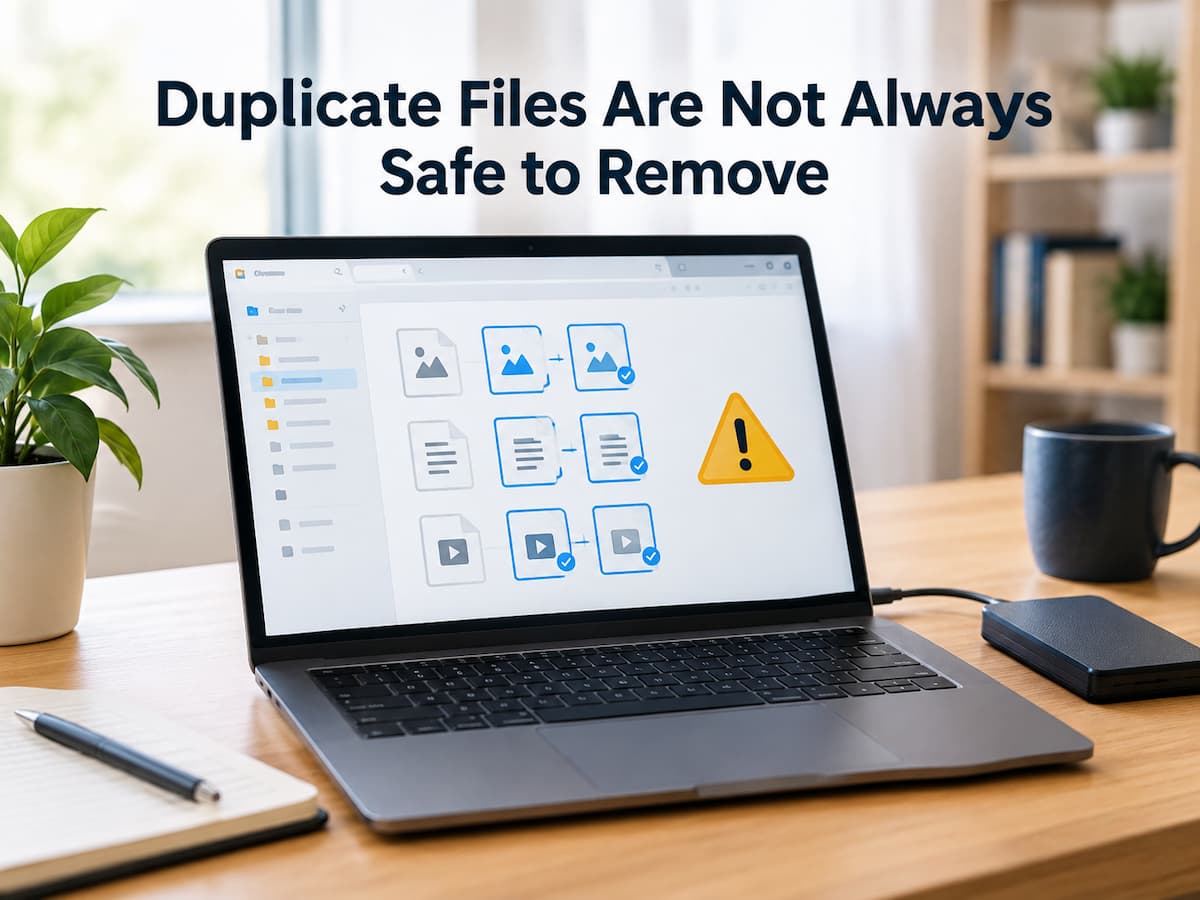
Duplicate files seem like an obvious target when a computer starts running low on storage. A cleanup tool may report hundreds of identical photos, documents, videos, or downloads and make deletion look like a simple solution. If two files have the same name or appear to contain the same information, removing one can feel completely harmless.
The problem is that files that look duplicated are not always interchangeable. One copy may be stored in a different location for a reason, one version may contain important changes, or a file may belong to a backup that should remain untouched. Even genuinely identical files can have different roles depending on where they are stored.
That is why duplicate-file cleanup deserves more attention than simply clicking “select all” and “delete”. The safest approach is to understand why the copies exist before deciding whether any of them can go.
Why Duplicate Files Appear in the First Place
Most duplicate files are created through ordinary computer use rather than a deliberate attempt to make multiple copies. You might download the same document twice, copy photographs from a phone several times, save different versions of a project, or move files between computers while leaving the originals behind. Cloud synchronisation can also create situations where the same material appears in more than one location.
Common sources include:
- Repeated downloads of the same file
- Phone and camera imports
- Backup software
- Cloud synchronisation
- Email attachments saved more than once
- File transfers between computers
- Shared project folders
- Exported copies of documents
- Manual copy-and-paste operations
The presence of duplicates is therefore not automatically a sign that something has gone wrong. Sometimes duplication is simply part of how a person’s files are organised.
A Matching Filename Does Not Prove Two Files Are Identical
One of the easiest mistakes is judging duplicates by filename alone.
A computer may create names such as:
report.pdfreport (1).pdfreport (2).pdf
These names suggest duplication, but the files may not contain the same information. One could be an earlier draft, another a revised version, and another an entirely different document that happened to receive the same filename. The opposite can also happen. Two files with different names can contain exactly the same data. For this reason, filenames are useful clues but poor evidence on their own.
Check the File Size and Date
Before deleting a suspected duplicate, compare basic file information.
File size
If two files have exactly the same size, that can be a useful indication that they may be identical. It is not absolute proof, however. Different files can occasionally have the same size.
Modified date
The modification date can help reveal which version came later. A document saved yesterday may be a newer revision than one created six months ago.
Location
Where the files are stored can be just as important as what they contain. A copy inside a backup folder should not automatically be treated like an unnecessary duplicate sitting in a temporary downloads folder.
These details give you context before you make a destructive decision.
A Duplicate in a Backup Is Not the Same as a Duplicate in Downloads
This distinction is especially important. Suppose you have a photograph in your normal Pictures folder and another copy inside a backup. Technically, they may be identical. Functionally, they serve entirely different purposes. Deleting the backup copy simply because another copy exists elsewhere could weaken your ability to recover the photograph later.
Before removing a duplicate, ask:
Is this copy serving as protection, or is it simply taking up unnecessary space?
A file can be redundant from a storage perspective while still being valuable from a recovery perspective.
Different Versions Can Look Almost Identical
Documents create another common problem. You may find several versions of a spreadsheet or presentation that appear nearly identical.
For example:
Budget.xlsx
Budget-final.xlsx
Budget-final2.xlsx
Budget-final-approved.xlsx
The differences may be small, but one version could contain the final figures or a correction that is missing from the others. This is why opening the files can sometimes be necessary. Comparing names and dates is useful, but when the contents matter, visual inspection is safer.
For important documents, search for changes in:
- Figures and totals
- Dates
- Signatures
- Attached information
- Formatting
- Comments
- Form fields
- Recent edits
A file that looks redundant from the outside may contain a small change that makes it important.
Photos Are Particularly Tricky
Photo collections often contain legitimate duplicates. A phone may create multiple copies during imports. Editing software may save an original and an edited version. Cloud services may keep synchronised copies of your files. Someone may also intentionally keep a full-resolution original while using a smaller version for sharing.
Deleting one without understanding the difference can leave you with the wrong version. For photographs, check whether the images actually match and consider resolution, dimensions, metadata, and edits. An edited image may look similar to the original but still be a separate file with a different purpose.
Pay attention to these photo differences.
- Original versus edited image
- Full-resolution versus compressed copy
- RAW versus JPEG
- Portrait versus cropped version
- Original metadata versus stripped metadata
- Master copy versus social-media export
Not every visually similar photograph should be treated as disposable.
Videos Can Have Even Larger Consequences
Duplicate videos deserve extra caution because they can consume large amounts of storage. A computer might contain several versions of the same video, but the files could have different resolutions, codecs, audio tracks, or editing changes. A 4K master file and a compressed 1080p copy may show the same footage but serve different purposes. Deleting the larger file simply because the smaller one plays correctly could remove the source material needed for future editing.
When dealing with video duplicates, compare more than the thumbnail. Check the resolution, duration, file size, and whether the video is an original production file or an exported copy.
Cloud Storage Can Make Duplicates Confusing
Cloud storage adds another layer of complexity because files may appear in multiple places without actually representing independent copies.
A synchronised folder can show the same file on several devices while maintaining a single underlying cloud copy. Deleting a file from one synchronised location may therefore also affect the other devices. Before deleting anything from a cloud-synchronised folder, you should understand what the service does.
Ask yourself:
- Is this folder synchronised?
- Is the file stored locally, online, or both?
- Will deleting it remove the cloud copy?
- Are other devices using the same file?
- Is there a separate backup?
A duplicate-looking file should never be removed simply because it appears on more than one device.
Be Careful With Program and System Files
Not all duplicate-looking files are personal documents. Software may legitimately store copies of configuration files, libraries, temporary data, caches, or other resources in different locations. Removing these files manually can cause unexpected problems.
This is one reason general-purpose duplicate cleaners should be used carefully. A tool may be technically correct in saying that two files contain similar data, but it may have no understanding of why each file exists. For ordinary users, personal folders such as Documents, Pictures, Videos, and Downloads are generally easier places to review manually than system directories.
When Removing a Duplicate Usually Makes Sense
There are situations where deletion is reasonably straightforward.
A duplicate is a stronger candidate for removal when:
- You have confirmed the files are genuinely identical.
- Both copies are in ordinary personal storage.
- Neither copy is part of a backup.
- You know which location you want to keep.
- The file is not required by an active project.
- You have another reliable backup of important material.
- Removing it will not affect synchronisation or any other applications.
The key word is confirmed.
The goal is not to remove the greatest number of duplicates. It is to remove unnecessary copies without reducing the safety or usefulness of your files.
When You Should Keep Both Copies
Sometimes keeping both files is the better decision. You may want to retain two copies when one is acting as a backup or when the files have different practical roles.
Keep both when:
- One copy is part of a verified backup.
- The files belong to separate projects.
- One is original, and the other is an edited version.
- One is a master file, and the other is an export.
- You are uncertain about their differences.
- The file is difficult or impossible to replace.
- The second copy is stored on a separate device for recovery.
Storage is useful, but not every megabyte is worth saving at the expense of reliability.
A Safer Duplicate-Cleanup Process
Instead of selecting every duplicate and deleting it at once, use a slower process.
1. Start with personal folders.
Begin with folders like Downloads, Documents, Pictures, and Videos. These are easier to understand than system folders.
2. Identify obvious duplicates
Look for files with matching names, sizes, dates, and contents.
3. Determine why both copies exist
Ask whether the second file is a backup, working copy, export, or accidental duplicate.
4. Choose a clear master copy.
If two files really are identical, decide which location makes the most sense for the copy you keep.
5. Move uncertain files instead of deleting them.
A temporary review folder gives you a chance to reconsider later.
6. Empty the recycle bin only after checking.
Deleting a file is one decision. Permanently removing it is another. Give yourself a final opportunity to catch mistakes.
This process takes longer than using an aggressive cleanup button, but it greatly reduces unnecessary risk.
Storage Space Should Not Be the Only Goal
Duplicate cleanup is often presented as a way to recover storage. That is useful, but storage is only one part of the decision. If deleting a duplicate saves 200 MB but removes an important backup, the cleanup has made the system less resilient. If removing an outdated project version saves a small amount of space but destroys information you later need, the trade-off is poor. A better question is:
Does this file provide enough value to justify keeping this particular copy?
That question considers both storage and usefulness.
What to Do With Files You Cannot Identify
Unknown files should not automatically be classified as duplicates. If you cannot identify a file, please investigate it before deleting it. Check its location, extension, date, size, and surrounding files. If it belongs to an old project or application, that context may explain its purpose.
For personal files, opening the document or viewing the image may answer the question quickly. If you still cannot determine whether it matters, please leave it alone for now. There is little benefit in making a permanent decision about a file you do not understand.
A Better Long-Term Approach to Duplicate Files
The best duplicate cleanup is the one that reduces the chance of creating the same problem again.
Simple habits can help:
- Keep one clear folder for important originals.
- Avoid downloading the same file repeatedly.
- Use descriptive filenames for projects.
- Separate active work from completed projects.
- Keep backups in clearly identified locations.
- Review large photo and video imports after transferring them.
- Avoid creating multiple unnecessary exports.
- Review synchronisation settings before deleting any cloud files.
You do not need a complicated filing system. You simply need to know which copy is the original, which duplicates are useful, and which ones were created accidentally.
Conclusion
It may seem like a sensible idea to get rid of duplicate files, but it is not always safe to do so. A second copy could be an accidentally downloaded copy, but it could also be a backup, a modified copy, the main file for a project, or a file saved in case it needs to be recovered.
Not just looking at filenames is the safest way to clean up files. Before you decide which files to keep, look at their contents, size, dates, locations, and what they’re used for. If you’re not sure, wait to delete instead of guessing.
A well-organised machine doesn’t remove rid of all copies. It is one where the important copies are used for what they were made for and where bad copies can be found without putting important data at risk.
FAQs
1. Can there be two copies of a file with different names?
Filenames don’t tell you whether two files have the same data or not. Two files with different names can have the same information in them.
2. Should I get rid of copies in my backup folders?
Usually, you should keep copies until you understand how the backup system works. You might need a copy in a backup to get your files back later.
3. Is it honest to use a tool that finds similar files?
It can be helpful, especially for big groups, but you should check the results again before deleting them. Automated software may mark files as similar without knowing what they are for or how important they are.
4. What is the best way to get rid of extra photos?
First, make sure that the pictures are really the same. Then, check to see which copy is the original, the edited version, the backup, or the higher-quality file. Keep the copy that meets your long-term needs the best.
5. Why do I have so many files that are the same?
It’s normal for downloads, backups, phone transfers, cloud synchronisation, file copying, and saving different versions of projects to happen more than once. They are often made automatically when people use computers every day.