
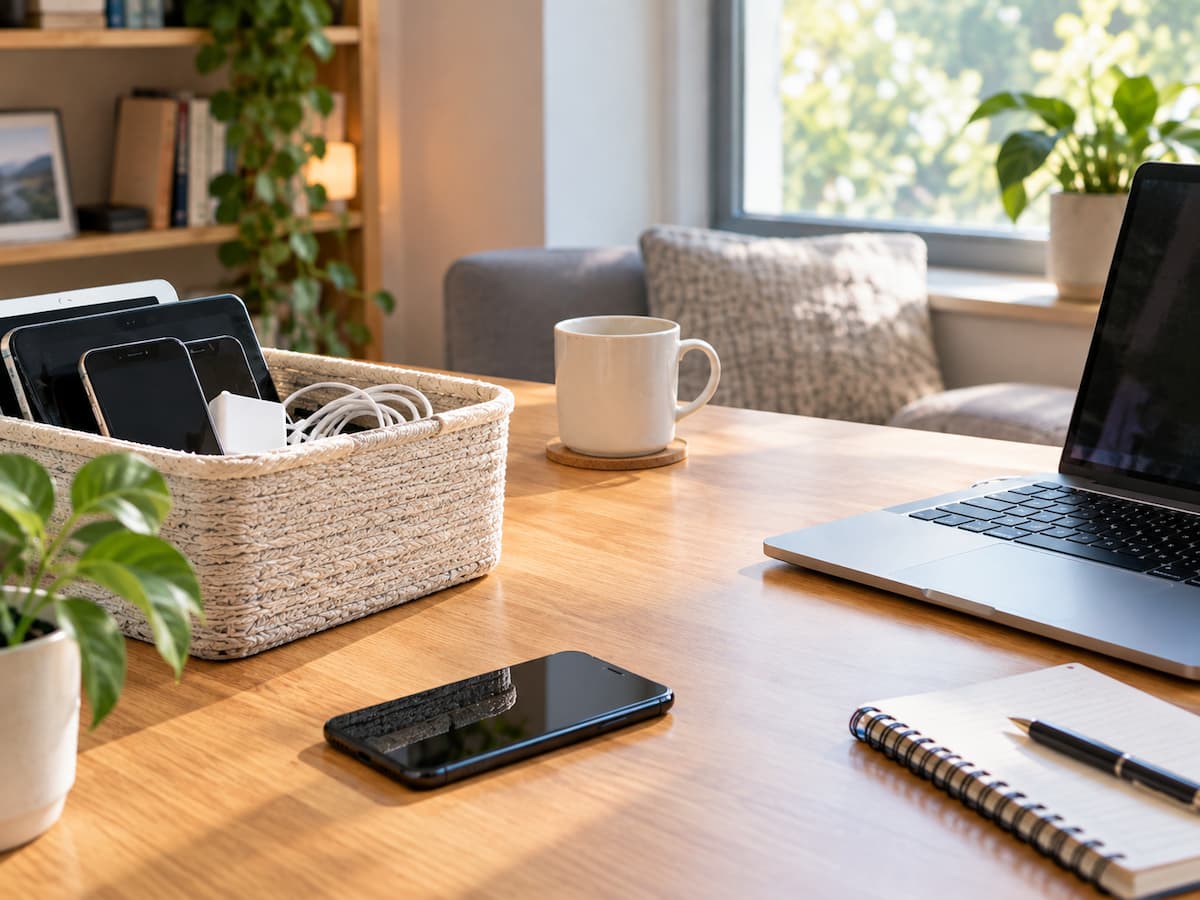
Digital clutter usually accumulates gradually. It builds quietly. A few unread notifications become dozens. Screenshots stay on the phone because they might be useful later. The Downloads folder fills with documents, images, and installers. Open browser tabs multiply, old applications stay installed, and files scatter across several places.
Eventually, the problem is no longer just clutter. It creates friction.
You spend time searching for things, close notifications without reading them, hesitate before opening a crowded folder, or feel like there is always something digital that needs attention. The natural reaction is to think that a complete cleanup is required. It usually isn’t.
Thirty focused minutes can create a noticeable reset if you stop trying to organise your entire digital life and concentrate on the things creating the most immediate friction.
Before the Timer Starts
The purpose of this reset is not to achieve digital perfection. It is to make your devices feel easier to use when the 30 minutes are over.
You do not need to reorganise every folder, review years of photographs, unsubscribe from every mailing list, or install a new productivity application. Those tasks can easily turn a short reset into an entire weekend project.
For this session, use four simple rules:
- Delete only what you clearly recognise as unnecessary.
- Move important items rather than leaving them in temporary locations.
- Do not spend more than a few minutes investigating one problem.
- Save complicated decisions for another day.
Set a timer for 30 minutes and start with the areas you interact with most.
Minute 0–5: Clear the Immediate Visual Noise
Start with whatever you see every time you use your device. For a computer, that might be the desktop. On a phone, the home screen might be the equivalent. The goal is not to organise everything behind the scenes. It is simply to remove the visual noise that makes the device feel chaotic.
Delete obvious temporary items and move files that clearly belong somewhere else. On a phone, remove unnecessary widgets or move rarely used applications away from the main screen if they are making it difficult to locate what you actually use.
Do not stop to investigate every file you see. If you see something and immediately know it is unnecessary, remove it. If you hesitate, just ignore it. Five minutes is enough for the first pass.
Minutes 5–10: Tame the Downloads Folder
Downloads are often where digital clutter becomes concentrated. Open the folder and sort by date or size. This can immediately reveal old installers, repeated downloads, temporary documents, large files, and items that no longer have a purpose. Search for the obvious candidates first.
A useful quick test is:
Why did I download this file?
- If the answer is clear and the original purpose has already ended, the file may be ready to remove.
- If it is an important document, please move it to its permanent location.
- If you cannot identify it, do not guess. Please set it aside for a more detailed cleanup later.
The objective is not to empty Downloads. The goal is to stop it from feeling like an unsorted storage room.
Minute 10–15: Deal With Screenshots and Recent Images
Screenshots are some of the easiest digital files to accumulate because creating one takes almost no effort. A useful screenshot may be something you need for a project, contains important information, or captures something you genuinely want to remember. But many screenshots have a brief lifespan.
You may have captured a delivery confirmation, a temporary conversation, a product page, an error message, a map, or a piece of information you needed for only a few minutes.
Once that purpose has disappeared, the screenshot may no longer deserve storage. During this five-minute section, focus only on recent screenshots and obvious duplicates. Do not start organising your entire photo library. That is a separate project.
Minutes 15–19: Remove Digital Interruptions
Some forms of digital clutter do not occupy storage at all. They occupy attention. Notifications clear a good example.
Open your notification settings and look at which applications are allowed to interrupt you. If an application regularly sends alerts that you aren’t concerned about, turn them off or reduce them. Think about the difference between information you need and activity that merely informs you.
You may want notifications for messages, appointments, security alerts, or important services. You may not need an alert every time an application has something new to show you. Reducing unnecessary interruptions can make a device feel calmer without deleting a single file.
Minutes 19–22: Close the Browser Tab Problem
Open browser tabs create a strange form of digital clutter because each tab represents an unfinished decision.
“I’ll read this later.”
“I need to compare these.”
“I might need this page.”
After enough time, the browser becomes a collection of postponed decisions.
Do a quick sweep.
Close pages you clearly no longer need. Bookmark only the pages you genuinely expect to revisit. If a page is merely something you thought might be useful someday, consider letting it go. For research or active projects, keep the relevant tabs open. The goal is not to achieve the mythical “zero tabs” state.
It is to remove the tabs that are no longer serving a purpose.
Minute 22–25: Check the Apps You Actually Use
Now look at your installed applications. You do not need to examine every program on the device. Look for obvious examples of software you installed for a one-time task and never used again. Maybe you downloaded an application to open one particular file. Maybe you tried a tool once and abandoned it. Maybe an old game or utility has been sitting unused for months.
If you know you no longer need an application, uninstalling it can simplify your device and sometimes recover storage. But do not remove unfamiliar system software just because you do not recognise the name. This is a quick review, not an experiment.
Minute 25–27: Clean Up One Communication Channel
Digital overwhelm often comes from communication rather than files. Choose one channel. It could be email, text messages, messaging applications, or another inbox. Do not try to reach inbox zero in three minutes.
Instead, remove the easiest sources of clutter. Delete obvious junk, archive conversations you no longer need in the main view, and mark important messages for later attention.
If email newsletters are responsible for a large portion of the noise, unsubscribe from one or two that you genuinely ignore. The important thing is to reduce the incoming pressure rather than simply rearranging it.
Minute 27–29: Create a Small “Later” List
At this stage, you will probably notice several problems that you cannot solve in thirty seconds. Perhaps your photo library needs sorting. Maybe an old external drive needs reviewing. You might discover hundreds of duplicate files or realise that your cloud storage needs a proper cleanup.
Do not start those projects now. Write them down.
A simple list such as this is enough:
Later
- Organise old photos
- Review duplicate files
- Sort archived documents
- Clean cloud storage
- Review unused accounts
This prevents unfinished tasks from occupying your attention while still ensuring you remember them.
Minute 29–30: Make One Rule for Tomorrow
Use the final minute to prevent the same clutter from immediately returning.
Choose one small rule.
For example:
- Downloads are temporary.
- Screenshots get reviewed every Friday.
- The desktop is for active work only.
- Unused notifications are turned off.
- Finished projects move into an archive.
Pick only one.
A single rule that you actually follow is more useful than ten rules that disappear from your mind after two days.
What You Should Not Try to Fix in 30 Minutes
A short reset works because it has limits. Some digital cleanup tasks deserve their own session rather than being squeezed into a quick reset.
Avoid starting these unless they are genuinely urgent:
- Sorting thousands of photographs
- Reorganising an entire hard drive
- Reviewing years of email
- Cleaning every cloud-storage folder
- Renaming large collections of files
- Removing old accounts
- Comparing every duplicate file
- Rebuilding your entire folder structure
These projects can require careful decisions. Rushing through them simply because a timer is running can lead to mistakes.
The Five-Minute Rule for Difficult Files
During the reset, you will eventually encounter something you cannot decide about. It could be an old document. Maybe it is a folder with a confusing name. Maybe you find several versions of the same project.
Give yourself a maximum of five minutes. If you can determine what it is and what should happen to it, make the decision. If not, stop. Please move it to a temporary review location or add it to your later list.
This is important because one difficult file can consume the entire session. A 30-minute reset should produce several small improvements rather than one deeply investigated mystery.
Focus on Friction, Not File Count
It is tempting to judge your progress by how many files you deleted. That is the wrong measurement.
Suppose you delete 500 screenshots but still cannot find your important documents. The computer may have less clutter, but your daily experience has not improved much.
Instead, look for friction.
- Can you find your current project more quickly?
- Is the desktop easier to understand?
- Are there fewer distracting notifications?
- Can you open your Downloads folder without feeling overwhelmed?
- Does your browser contain fewer forgotten tabs?
Those improvements matter more than the number of deleted files.
What a Successful 30 Minutes Looks Like
At the end of the session, your digital life does not need to look perfect.
A realistic result might be:
- Your main screen: less visually crowded.
- Downloads: obvious clutter removed and useful files relocated.
- Screenshots: unnecessary recent captures deleted.
- Notifications: fewer interruptions.
- Browser: fewer abandoned tabs.
- Apps: obvious unused software removed.
- Inbox: some immediate clutter has been reduced.
- Future tasks: written down instead of floating around in your head.
That is enough. The reset has done its job if the next time you use your device feels slightly easier.
Don’t Turn the Reset Into a Daily Chore
There is a danger in digital decluttering: becoming obsessed with maintaining perfect organisation. You do not need to inspect every folder every evening.
The purpose of the reset is to restore control, not create another obligation. Let some clutter exist.
A computer, phone, or tablet is a working environment. Files will accumulate. Messages will arrive. Screenshots will be created. New applications will be installed. The goal is to prevent normal activity from becoming overwhelming, not to eliminate every trace of it.
When Thirty Minutes Is Not Enough
Sometimes digital clutter reflects a larger problem. If you have years of unsorted files, multiple old computers, several cloud accounts, thousands of photographs, or important documents scattered across different locations, a short reset will only address the surface. That is fine.
Use the 30-minute session to identify the biggest sources of friction and decide what deserves a longer project.
You might discover that your biggest problem is not storage at all. Perhaps you cannot remember where files belong. Maybe your phone is filled with unnecessary notifications. Perhaps you have too many places where information is stored.
Once you know the actual problem, a longer cleanup becomes much easier to plan.
A Digital Reset Should Leave You With Less to Think About
The best result of a quick cleanup is not an empty folder. It is fewer small decisions competing for your attention.
You know where current files belong. You have removed some obvious clutter. Your screen is less distracting. You have stopped postponing a handful of tiny decisions. Most importantly, you have identified which problems can wait.
That is what makes a short reset so useful. It creates enough breathing room to make the next digital task feel manageable instead of overwhelming.
Conclusion
A well-organised digital life doesn’t have to be perfectly tidy to be manageable. Often, just thirty minutes of focused attention can effectively reduce the most glaring and annoying clutter.
Begin with what you can see. Clear out obvious temporary files, review recent screenshots, cut down on unnecessary notifications, close abandoned browser tabs, check apps you rarely use, and streamline your communication channels. When faced with complex issues, resist the urge to solve them all immediately.
The goal isn’t to complete all your digital decluttering in half an hour but to make your devices more user-friendly in the moment while creating clearer paths for tasks yet to be done. Occasionally, this brief adjustment can relieve the frustration caused by digital clutter.
FAQs
1. Is 30 minutes really useful?
Yes. Thirty minutes won’t completely reorganise a chaotic digital life, but it can alleviate the most glaring and irritating issues. The key is to focus on the areas most likely to cause distraction, rather than trying to clean up everything.
2. What should I clear out first?
Start with the digital environments you use most often. For many, this means their computer or phone home screen, downloaded files, screenshots, notifications, browser tabs, or frequently used inboxes.
3. Should I delete everything I haven’t used recently?
No. Some files and apps you don’t use often may still be important. Only delete items if you are sure they are no longer needed—don’t base the decision solely on how long they’ve been stored or how inactive they are.
4. What if I find important files during the reset?
Move them to a suitable, permanent location rather than leaving them in a temporary folder. If you’re unsure where to put them, please add them to a clearly labelled to-do list and tackle them later.
5. How often should I perform a digital reset?
There is no set frequency for resets. Some people find a quick weekly reset helpful, while others only need to reset when digital clutter starts to hinder their daily workflow.