
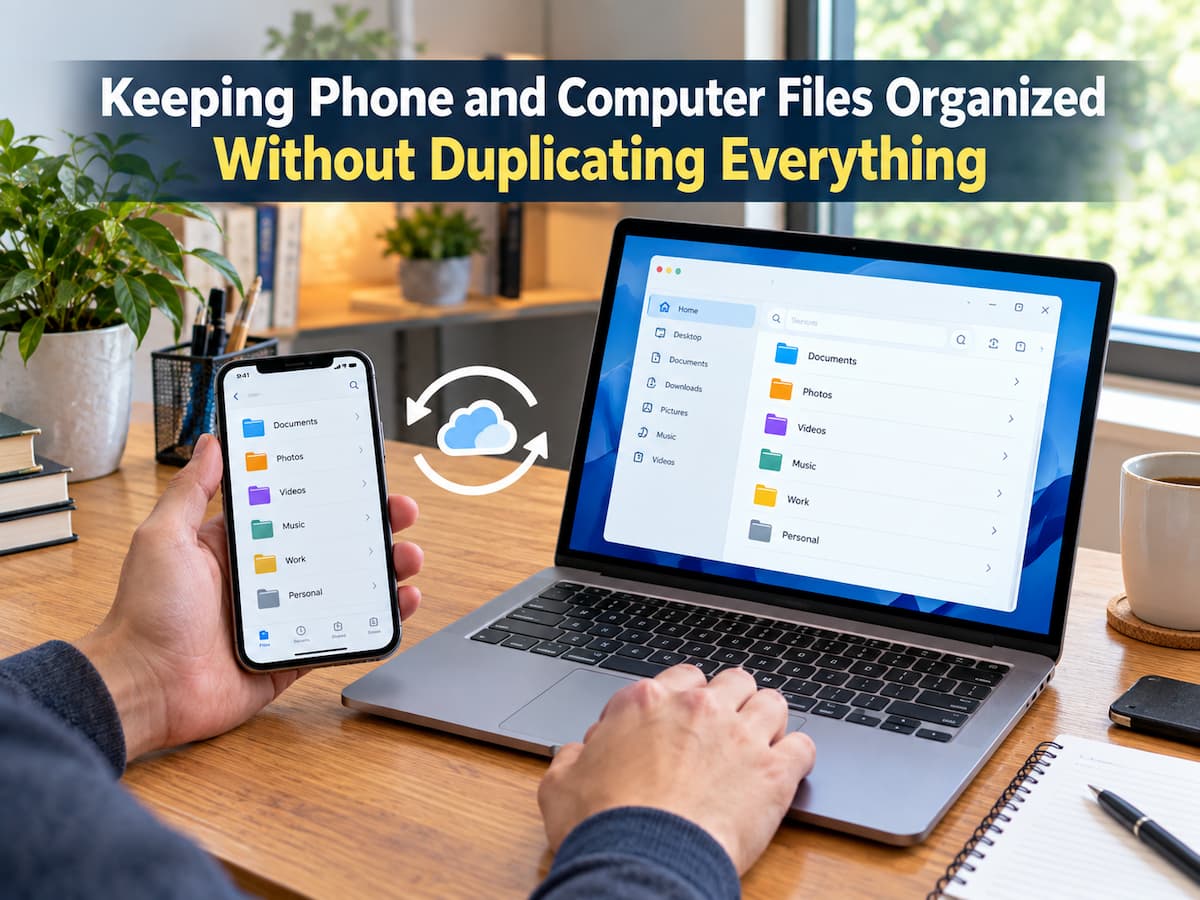
Your phone can quietly turn into a second filing cabinet. Photos are sent via instant messaging apps, screenshots accumulate, documents are downloaded, and files are transferred to your computer “just in case”. That same content then reappears in cloud storage, on external hard drives, in email attachments, and even in other folders on your computer. If you check just one device at a time, everything seems fine. But when you try to locate the original file, the problem becomes apparent.
Was that photo on your phone or your laptop? Did you move the document or copy it? Is the folder on your computer up to date? Did you transfer those videos last month? The solution isn’t to stop saving files across multiple devices. Some duplicate files are useful—sometimes even necessary. The real goal is to understand why a file appears in each location and to prevent accidentally copied files from permanently adding to the clutter.
The Phone and Computer Do Not Need to Be Identical
One of the easiest ways to create digital clutter is assuming that every device should contain the same files.
A phone is usually used for capturing, receiving, viewing, and quickly sharing information. A computer is often better suited to editing, long-term storage, detailed work, and larger collections. Those different jobs mean the two devices do not need identical libraries.
| Device | Natural Role | Files That Often Belong There |
|---|---|---|
| Phone | Capture and quick access | Recent photos, screenshots, downloaded documents |
| Computer | Working and organizing | Projects, edited photos, documents, large files |
| Cloud storage | Access and synchronization | Selected active files and shared material |
| External storage | Backup and long-term retention | Important archives and large collections |
This simple distinction changes the question from “How do I make everything match?” to “Which device should be responsible for this file?”
That is a much easier problem to solve.
Decide Where the Original Lives
Every important collection benefits from having a primary home. This does not mean there can only be one copy. It means you can recover the photograph you consider authoritative.
For example, you might decide that:
- New photos temporarily live on your phone.
- Selected photos are transferred to the computer.
- Finished photo collections are stored in a dedicated archive.
- Important documents have their primary home on the computer.
- Cloud storage holds files that need access across devices.
- Backup storage contains recovery copies rather than everyday working files.
Without this distinction, every copy starts looking equally important.
That is when a simple synchronization problem turns into a file-management problem.
Copying a File Is Not the Same as Backing It Up
The words “copy” and “backup” are often used as though they mean the same thing. They do not. If you copy a photograph from your phone to your computer because you want to edit it, that is a transfer or working copy. If you keep another copy specifically so the photograph can be recovered after device failure, that is part of a backup strategy.
The difference matters because people sometimes assume that having the same file on two devices automatically protects them. It may not. If both devices synchronise changes, a deletion or unwanted change can potentially affect both locations. A proper backup strategy needs to consider how files can be recovered if something goes wrong.
Create a Transfer Habit Instead of Randomly Moving Files
The phone-to-computer process becomes messy when every transfer happens differently. One week you drag photos into the Pictures folder. The next week you email them to yourself. Later you use a cloud service. Then you connect a cable and create another folder called Phone Photos.
After several months, you still have no consistent record of what you have already moved. A better approach is to establish one normal transfer path.
For example:
Phone → Temporary Transfer → Computer Library → Archive
The exact folders can vary, but the process should remain predictable. This is particularly useful for photographs and videos. Once a batch has been safely transferred and checked, the phone can eventually be cleaned without accidentally deleting the only copy.
Screenshots Are One of the Biggest Sources of Duplicate Clutter
Screenshots deserve special attention because they are often temporary by nature. A screenshot may be useful for five minutes, several weeks, or several years. The problem is that the phone does not know which category it belongs to. Over time, screenshots can appear in several places:
Phone gallery → automatic cloud backup → computer photo library → Downloads folder
Suddenly one screenshot exists four times. Not every screenshot needs long-term preservation. Before transferring or backing up a large screenshot collection, consider whether the image contains information you will genuinely need later.
A useful distinction is:
| Screenshot Type | Likely Treatment |
|---|---|
| Temporary reference | Delete after use |
| Travel confirmation | Keep until the trip is complete |
| Important receipt | Move to document storage |
| Useful tutorial or instruction | Keep if still relevant |
| Personal memory | Move into the photo library |
| Duplicate image | Remove after verification |
This prevents screenshots from quietly becoming a second photo archive.
Photos Need a Clear Exit From the Phone
Phone photography creates a particular organisational problem because cameras make capturing information almost effortless. A person can take hundreds of photos during a trip without thinking about storage. The difficulty comes later when those photos need to be sorted. Instead of repeatedly copying individual images, it can be easier to think in batches.
A trip might move through a simple process:
Capture → Transfer → Review → Organize → Backup
The important part is not doing every step immediately. It is knowing what each stage means. The phone is the capture device. The computer becomes the place where the larger collection is reviewed. The archive holds the material worth preserving. That division keeps the phone from becoming the permanent home for every photograph you have ever taken.
Do Not Create a New Folder Every Time You Transfer Something
A common habit is creating folders with names such as:
Phone PhotosPhone Photos NewPhone TransferPhone BackupPhone Photos JunePhone Photos June 2
The names may seem harmless, but they eventually make it difficult to understand which folder is current. A better approach is to give transfers a predictable destination and organise the files afterward.
For example:
Photos
├── 2025
├── 2026
└── To Review
The temporary area has a clear purpose. Once the files are processed, they leave. The important thing is not creating the perfect transfer folder. It is preventing temporary transfers from becoming permanent storage locations.
Cloud Storage Can Solve One Problem While Creating Another
Cloud storage is extremely convenient for accessing files from multiple devices. It can also make duplication harder to notice. A file may appear on the phone, computer, and cloud service without you realising that all three are connected copies of the same underlying file.
That is not automatically bad. In fact, synchronisation can be exactly what you want. The problem begins when you also manually copy the synchronised folder into another folder because you are unsure whether it is already backed up. Before making another copy, ask:
What purpose will this copy serve?
If the answer is “I just want to make sure I have it,” check your existing storage and backup arrangement first. More copies do not automatically provide more security. Sometimes they simply provide more opportunities to become confused.
Use Names That Reveal the Relationship Between Files
When the same material appears on multiple devices, filenames become especially important.
Imagine seeing these files:
IMG_4821.jpgIMG_4821 (1).jpgIMG_4821 final.jpgIMG_4821 edited.jpg
It is difficult to know which one should be kept.
A clearer naming approach might be:
2026-07-18 Mountain Trip - Original.jpg2026-07-18 Mountain Trip - Edited.jpg
Now the relationship between the files is obvious. You do not need to rename every file on your phone manually. But once important material enters your long-term computer archive, descriptive names can make future cleanup much easier.
Working Copies Should Have an End Point
A working copy exists because you are doing something with it. You download a document to edit it. You copy a video to a computer to trim it. You transfer photos because you want to select the best ones. The problem occurs when the task finishes, but the working copy remains indefinitely.
Eventually you may have:
- The original file.
- The edited version.
- An exported version.
- A compressed version.
- A file sent to someone else.
- A duplicate downloaded again.
- A copy is sitting in Downloads.
Not all of these need permanent storage. Once a project is complete, take a moment to determine which version is actually worth retaining. This small decision can prevent years of unnecessary duplication.
Some Duplication Is Actually Sensible
Trying to eliminate every duplicate file can be just as unhelpful as keeping everything.
Important files may reasonably exist in more than one location.
| Situation | Multiple Copies Useful? |
|---|---|
| Important personal photographs | Yes |
| Critical documents | Often |
| Active project files | Sometimes |
| Temporary downloads | Usually not |
| Easily replaced installers | Usually unnecessary |
| Duplicate screenshots | Usually not |
| Finished exports with no future value | Often unnecessary |
The important distinction is between intentional redundancy and accidental duplication. Intentional redundancy has a reason. Accidental duplication usually exists because nobody knows whether another copy already exists.
Be Careful With Automatic Synchronization
Synchronisation is convenient because a file edited on one device can appear on another. But synchronisation should not be confused with a simple one-way transfer. If you delete a synchronised file from one location, that change may be reflected elsewhere depending on the service and its settings.
This is why it helps to understand whether a tool is being used for:
Synchronization
Keeping files available across devices.
Transfer
Moving or copying files from one device to another.
Backup
Maintaining a recoverable copy in case something is lost or damaged.
Archive
Keeping older material for future reference.
These purposes can overlap, but they are not identical. Understanding the difference makes device storage decisions much easier.
Give Temporary Files Somewhere to Go
Not every file can be organised immediately. You might receive ten photos from someone, download a contract, or save a document that you need tomorrow. Forcing yourself to decide its permanent location immediately can make organisation feel like work.
A temporary folder can solve that problem. The important part is giving the folder a defined role.
For example:
Computer
└── To Sort
Files can stay there briefly while you decide what to do with them. But if it To Sort contains material from the last three years, it has stopped being temporary. A temporary folder works best when it acts like an inbox rather than an archive.
Avoid Editing the Same File in Multiple Places
Version confusion often begins when one file is edited on two devices. Suppose a document exists on a laptop and phone. You make changes on the laptop, then later open an older copy on the phone and make different changes.
Which one is correct?
The safest way to avoid this situation is to establish a clear working location for important documents. For example, if a document is actively being edited on the computer, treat that computer copy as the working version. Other devices can be used for viewing or accessing the synchronised version where appropriate, but avoid creating separate manually edited copies unless you have a reason to do so. One active version is much easier to manage than several competing versions.
Organize Around What You Will Search For
People often organize files according to how they were transferred.
That is rarely how they will look for them later.
You may remember:
“I need the photos from our vacation.”
You probably will not remember:
“I need the files I transferred from my phone on July 14.”
This is why the long-term folder structure should reflect meaningful subjects, events, projects, or dates rather than the technical method used to move the files. The transfer method is temporary. The reason you care about the file is usually permanent.
A Simple Phone-to-Computer Workflow
For someone starting with a messy collection, a basic workflow might look like this:
PHONE
  ↓
TRANSFER
  ↓
COMPUTER
  ↓
REVIEW
  ↓
ORGANIZE
  ↓
BACKUP / ARCHIVE
At the review stage, unnecessary screenshots, duplicates, blurry photographs, and temporary files can be removed. At the organisation stage, important material receives a proper home. At the backup stage, valuable files receive appropriate protection. The phone does not need to remain a complete historical record of everything you have ever captured.
What to Do When Both Devices Are Already Full of Duplicates
If your phone and computer already contain years of overlapping files, do not begin by deleting everything that looks duplicated. Start with identification.
Choose one collection, such as photographs from a particular year or documents related to a specific project. Determine which location contains the version you actually want to keep. Then compare the other copies.
A safe cleanup usually follows this general pattern:
- Identify the collection.
- Decide which location should be the primary home.
- Confirm that important files exist there.
- Confirm that an appropriate backup or recovery copy exists.
- Remove unnecessary duplicates only after verification.
- Repeat with the next collection.
This is slower than pressing “delete all duplicates,” but it greatly reduces the chance of removing something you later discover was important.
The System Should Tell You What Each Copy Is For
You do not need a complicated spreadsheet to track your files.
A few clear roles are usually enough:
| Location | Purpose |
|---|---|
| Phone | Capture and temporary access |
| Computer | Main working library |
| Cloud | Synchronization or convenient access |
| Backup | Recovery |
| Archive | Older material worth preserving |
Once those roles are clear, duplication becomes easier to judge.
Two copies of a file are no longer automatically suspicious. You can ask whether each copy has a different purpose. If they do, both may be useful. If they do not, one may simply be clutter.
A Little Redundancy Is Better Than Perfect Minimalism
Digital organisation should never become a competition to have the fewest possible files. Important photographs, documents, projects, and records may deserve more than one copy. Trying to remove every duplicate can create unnecessary risk, particularly when you are not certain which version is original or whether a backup is available.
The better goal is controlled redundancy. Keep additional copies when they serve a clear purpose. Remove copies that exist only because you forgot they were already in another location. That distinction is much more practical than trying to maintain a perfectly duplicate-free computer.
Conclusion
Your phone and PC don’t have to be mirror images of each other. They just need to know what they’re responsible for. The phone may be a place where information comes in and where memories can be made. The computer might become the main place for organising and working. Cloud services can offer synchronisation and access, while independent backup storage can help secure sensitive information. When each location has a purpose, duplicate files are much easier to understand. Some copies are fine. Some are leftovers from transfers, downloads, revisions, or syncs you’ve forgotten about.
The aim is not to delete all duplicates. That nobody gets. It is to quit making copies. Ultimately, knowing where the original belongs, why there’s another copy, and when a temporary copy can be disposed of makes moving files between your phone and computer a routine task, not another source of digital clutter.
FAQs
1. Do my phone and PC need to have identical files?
Nope. They may share files, but they don’t have to have the same libraries. Depending on how you use each item, it can serve a different purpose.
2. Is backing up images from my phone to my PC copying them?
Not really. It makes another copy. Whether it is a backup or not depends on how that copy is protected and whether it can be recovered if the original is lost.
3. How can I prevent duplicating photos?
Use the same transfer technique consistently. Do not manually import the same batches many times. Verify if the files for large collections have previously been moved before moving large collections.
4. When I transfer the images from my phone, do I have to erase them?
If the transfer has been authenticated and you have a proper copy/backup somewhere, then you can. Don’t delete the files just because they appear on the computer until you’re sure the transfer was successful.
5. Is cloud sync secure enough for my files?
Synchronisation and backup are two different functions. A file in sync can even be deleted or changed in an undesired way. Critical files should have a recovery plan that matches their value.
6. Where do I store phone screenshots?
Temporary screenshots can be removed when they are done with. Important screenshots should be moved to a more appropriate area, such as a document store or photo collection, instead of allowing the screenshot folder to become a permanent repository.