
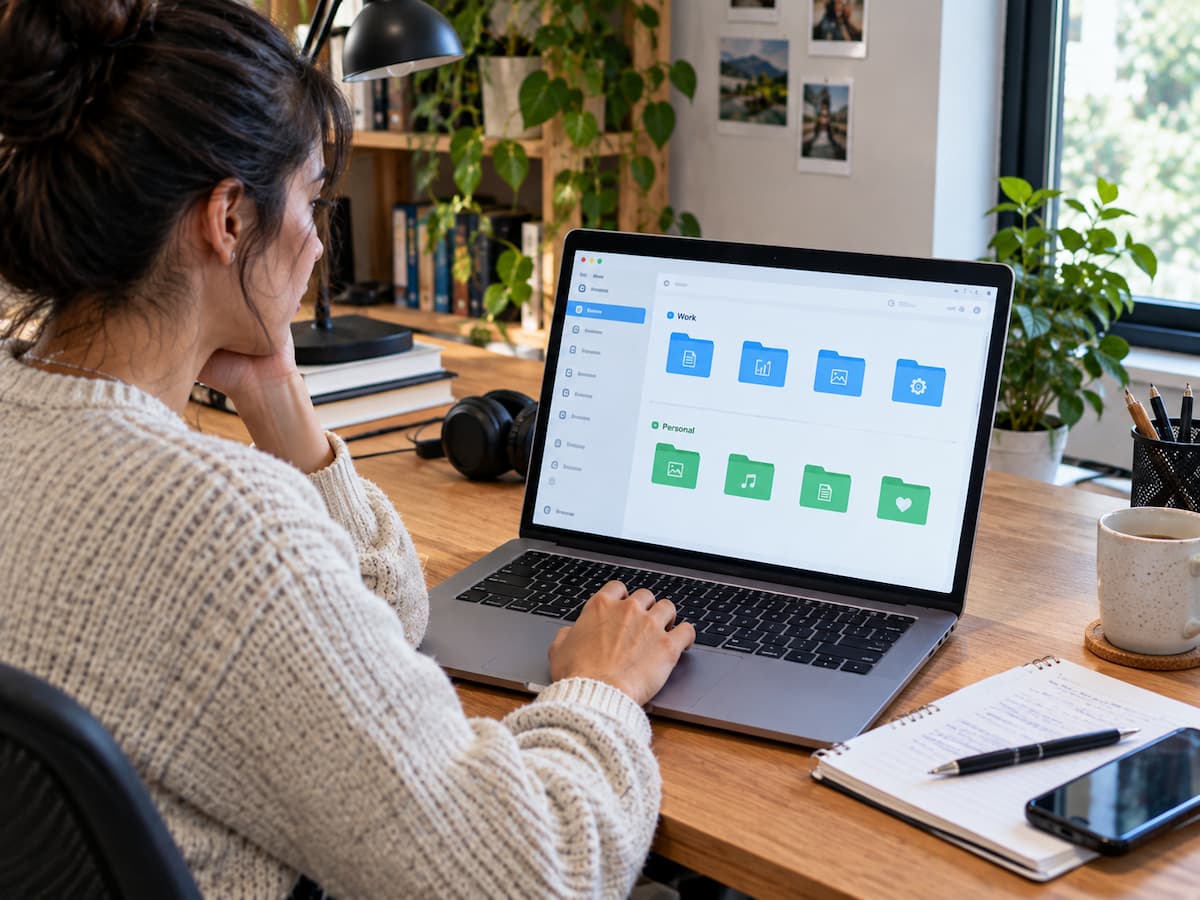
Freelancers typically live two lives inside the same computer. On one side, client briefs, invoices, contracts, project files and tax documents, drafts and business records. The other has family photos, personal documents, travel bookings, downloaded files, shopping receipts and everything else that comes with normal life. Trouble begins when those two sides gradually merge. A customer logo might be next to a picture of a passport, a personal photo could be in a project folder, and a crucial invoice could be lost among downloads with nothing to do with work. Nothing is officially lost, but it takes longer than it should to find the proper file. You don’t need to build a complex business archive to have a suitable filing system for freelancers. It only has to be a clear line between professional and personal info while allowing for adequate leeway for actual life.
Start by Separating the Two Lives
One of the easiest and most helpful choices is that business files and personal files should have clearly different homes. That doesn’t always mean employing two computers or two storage providers. This is about building a visual border that tells you what a file is for before you even open it. This can be supplied by a main folder for work and a second for personal items. In the workspace, projects, money, administration, and reference material might have their separate spaces. Personal files can have completely distinct arrangements since they meet various needs. This distinction is important because freelancers often switch between different roles throughout the day. One person may work on a client’s video in the morning, issue an invoice in the afternoon and book a flight in the evening. So, if all three of these actions are occurring inside a huge Documents folder, the computer is just as confused. Separating the two sections decreases the number of selections you need to make every time you save something.
Your Work Folder Should Reflect How You Actually Earn Money
There’s no perfect folder layout that works for every freelancer because different sorts of work produce different kinds of files. A photographer might think in terms of clients and shoots; a writer might naturally think in terms of clients, publications and assignments.” A designer may need project stages, assets, outputs and changes. The main thing is not to follow somebody else’s structure. Your work folder should reflect the way your firm already works. If most of the files are for certain clients, then client folders may be logical. If you do a lot of short projects, organising them by year or project might be easier. The point of a structure is to not have to pause for a few minutes to figure out where a new file should go. If you often create a folder and immediately find yourself wondering where it should belong, the system is likely too complex for the work you actually do.
Personal Files Need Their Own Logic
Personal information needs to be structured separately because it changes at a different rate than professional activity. Some tax documents are important for years, but a client draft is useless after a project is complete. Family images, travel documents, domestic records, education files, and personal receipts. They may require different types of care. Putting them in a corporate folder simply because they are saved on the same computer just adds further complexity. A distinct personal space lets these files build their own system. It can also stave off a common freelancer issue – seeing everything as a business document. Not every PDF needs a project folder in a client manner, and not all personal files need a formal naming structure. The idea is to have enough separation that work information remains professional and personal information remains manageable.
The Desktop Is a Workbench, Not a Filing Room
Freelancers utilise the desktop as a temporary location to work and then forget that temporary files have a way of becoming permanent. A contract you downloaded, an exported image, a screenshot from a client conversation, a personal document — these things all wind up sitting next to each other. The desktop is nice because you can see everything right away, but seeing everything doesn’t mean you’re organised. A better way is to regard the desktop like the physical desk. While actively working on files, they can be dropped there, but they should eventually migrate to their proper home. This is not to say you should incessantly check your desktop every night. Even the act of cleaning it when you can’t see the wallpaper anymore can keep temporary work from becoming permanent clutter. The key difference is that the desktop is a staging place, not the end point for essential information.
Your Files Should Not Depend on Downloads
Another concern is the Downloads folder, which literally takes virtually everything and asks questions later. A customer provides a PDF, a browser stores a picture, an online service creates a document, and a personal purchase creates a receipt. They all end up in the same location. That’s great for getting files but bad for long-term storage. Treat downloads like an inbox. Don’t try to create a file structure that lasts. Open the files that matter, rename them if necessary and transfer them to the professional or personal area to which they belong. Some files can be removed after use. Others need to be kept. If you think of Downloads as an arrival point, not an archive, the folder is considerably easier to administer because you no longer expect it to remember where everything belongs.
Client Files Easier With Clear Boundaries For Every Project
One of the most useful habits for freelancers is to assign a designated home for each major job. You don’t need to have dozens of precisely constructed subfolders in a project folder. It just needs to keep the critical bits together. If a project has a contract, source material, working files, exports and final deliveries, putting these materials in a project area that we can recognise makes the project easier to grasp months down the line. This is particularly useful when an old client returns with a question about something you built before. This gives you a reasonable place to start instead of looking in a bunch of unrelated places. The project boundary also helps to prevent personal files being accidentally mixed up. A client folder should be a little self-contained work area, not another branch of your whole computer.
Financial Records Need a Different Kind of Organisation
Business finance is not like a normal project file that you might find long after a project has been completed. This means that items like invoices, receipts for expenses, contracts, payment records, and tax-related documents can be benefited by a temporal rather than project-specific structure. But a freelancer can remember an expense from last year but not whose customer it pertained to. A financial archive by year makes such a search simpler. It also avoids financial documents from being lost in outdated customer files. Some projects can fade from your current work a few months down the line, but the financial record attached to it can be relevant for much longer. One of the little improvements that can make a freelance file system considerably more lasting is to separate cash management from day-to-day project activity.
Not Every File Needs to be Copied Everywhere.
The need to have numerous copies of everything increases when work and personal files are stored on different devices. A laptop, a phone, an external drive and a cloud account can quickly be home to several versions of the same document. Sometimes, more copies provide useful protection, but uncontrolled duplication makes it harder to recognise which version counts. Knowing why the second copy is there is handy before copying a file. Backup is not a functional copy. An archive is not the same thing as a file that you share with another device. If the reason goes away, the additional copy might not be useful any more. This mindset is especially relevant for freelancers, as business files can get out of control rather rapidly. If you’re working with movies, photos, design files and exported versions, some big projects can take up more storage space than years’ worth of personal paperwork.
The Naming System Should Work in Both Worlds
Work and personal folders may be structured differently, but there are still a few name conventions they have in common. A good filename should tell you enough about the file to identify it without having to open it. Date can be helpful when timing is critical, and a short description can assist in distinguishing similar articles. With freelance work, the project or customer name is more relevant than something nondescript like “document” or “new version”. Personal files can be easier. The idea is not to make every filename into a sentence. It’s to make sense of old files when your recollection of the situation has gone. After a few years, a file named “contract.pdf” doesn’t tell you much. A filename with the relevant customer, project or date provides future-you a far better hint. Good filenames mean your folders don’t have to look so hard for you.
Do Not Allow Completed Projects to Overtake Active Work
Freelancers tend to save everything because they’re scared they might need it again. That’s understandable, especially when a former customer sends for an old file out of the blue. But doing projects mixed in with current work complicates the day-to-day. A separate archive offers a halfway ground. Completed projects can still be accessible without taking up room with ongoing tasks. The archive can be sorted by year or client or whatever is appropriate for the business. It doesn’t have to be perfect; you’re not going to visit it every day. Its primary goal is to get old material out of the way, yet keep it recoverable. There’s a psychological benefit to this, too. When the active workspace is primarily still-work-needed stuff, it feels less overwhelming to open it.
A Freelancer’s Filing System Must Survive Busy Weeks
Test your file system on the days when you are too busy to bother about organisation. If the system only works if you have a lot of time, then it will fail eventually. Freelancers have to contend with tight deadlines, last-minute client requests, late-night changes and weeks where admin work gets neglected. In those times, you want a system that nevertheless enables logical decisions. A file should have an apparent destination even if you simply spend a few seconds to think about it. A temporary section can be useful when you can’t file something immediately. The point is to provide that temporary place boundaries so that it doesn’t silently become another permanent archive. Being well-organised is not about pretending to be perfect. It’s about making the right thing easy and the messy thing hard.
Make Shared Rules Small
At some point organisation becomes just a different type of job. A freelancer doesn’t need a twenty-page filing manual to keep a computer in check. A short list of good guidelines may be better than a long list of detailed instructions. Do not mix work and personal files. Active initiatives have a defined home. Financial records have their place. Both the downloads and the desktop are transitory places. When projects are completed, they are put in an archive. Important files get comprehensible names. The ideas are easy enough to remember so you don’t have to review the guide every time a file comes in. And that simplicity is a strength, not a weakness. Easy-to-recall rules are more likely to endure changes in software, clients, devices and working habits.
The Best System Is the One You Can Rebuild Later
A good filing system doesn’t have to tell you where exactly every file is from memory. It should give you enough clues to work the thing out. That is a significant difference. Freelancers may develop processes based on what makes logical sense now, and the structure gets complex six months later. Your future self won’t recall why you created a folder called “Misc”, why there are 3 versions of a contract in different places, or which client was associated with some bizarrely named project. A more robust system leaves traces. Names of folders explain purpose. File names describe contents. Archives tell age. Context is explained by the separation of professional and personal domains. It is basically leaving a map for someone who happens to share your name and your computer, but not your present memory.
Organisation Is Not Designed to Consume Attention But to Defend It
The true value of a freelance filing system isn’t in how neat the folders seem. It is how much the system pays attention to you back. Small moments of friction that are removed from the workday: finding a contract without having to recall exactly when you downloaded it, finding an old project without searching the whole computer, and keeping personal docs separate from client work. Each moment may not seem like much in itself, but over the months and years they add up. A handy solution silently deals with the mundane side of digital life so you can spend more time performing the stuff that actually pays you. That’s why separation is more important than perfection. There is no need for a big border between work and personal files. They just need clean houses, sensible names and sufficient consistency that finding things later is not another freelance effort.
Conclusion
A freelance computer does not have to become a flawless digital office. All you need is enough structure to keep the many elements of your life separate and vital information easy to retrieve. Work files need a home, personal files need their own home, and transitory places like Downloads and the desktop should not be used as a permanent home. From there, basic naming conventions and a sensible archive will take care of much of the rest. The most detailed filing system is not always the best filing method. It’s the one that still makes sense when you’re busy, weary, switching between clients, or trying to find that document you haven’t opened in months. When an organisation works quietly in the background, your files cease demanding attention and start to support the way you actually work.
FAQs
1. How many folders should a freelance work file system have?
There is no one size that fits all. You can always add another level if the current one gets unwieldy. Start with the few categories that match how you actually work. If you end up making folders to put one or two files in, your system can be overly complicated.
2. What happens to outdated client projects?
You can more easily put projects already finished in an archive than in the middle of active development. For example, you may sort the archive by year, customer or project type, based on how you are most likely to recall something when you are looking for an old file.
3. Is cloud storage sufficient for freelance files?
Using cloud storage is handy for access and syncing but by default should not be considered a complete backup plan. Important corporate files require a storage strategy that takes into account unintentional deletion, device failure, version history and recovery.
4. What do freelancers do with files that they can’t organise right away?
Don’t rush into a choice; give them a temporary home. The crucial thing is to keep going back to that temporary spot now and then. A temporary folder is as good as it is just temporary – it’s just another clutter problem if nothing ever leaves it.