
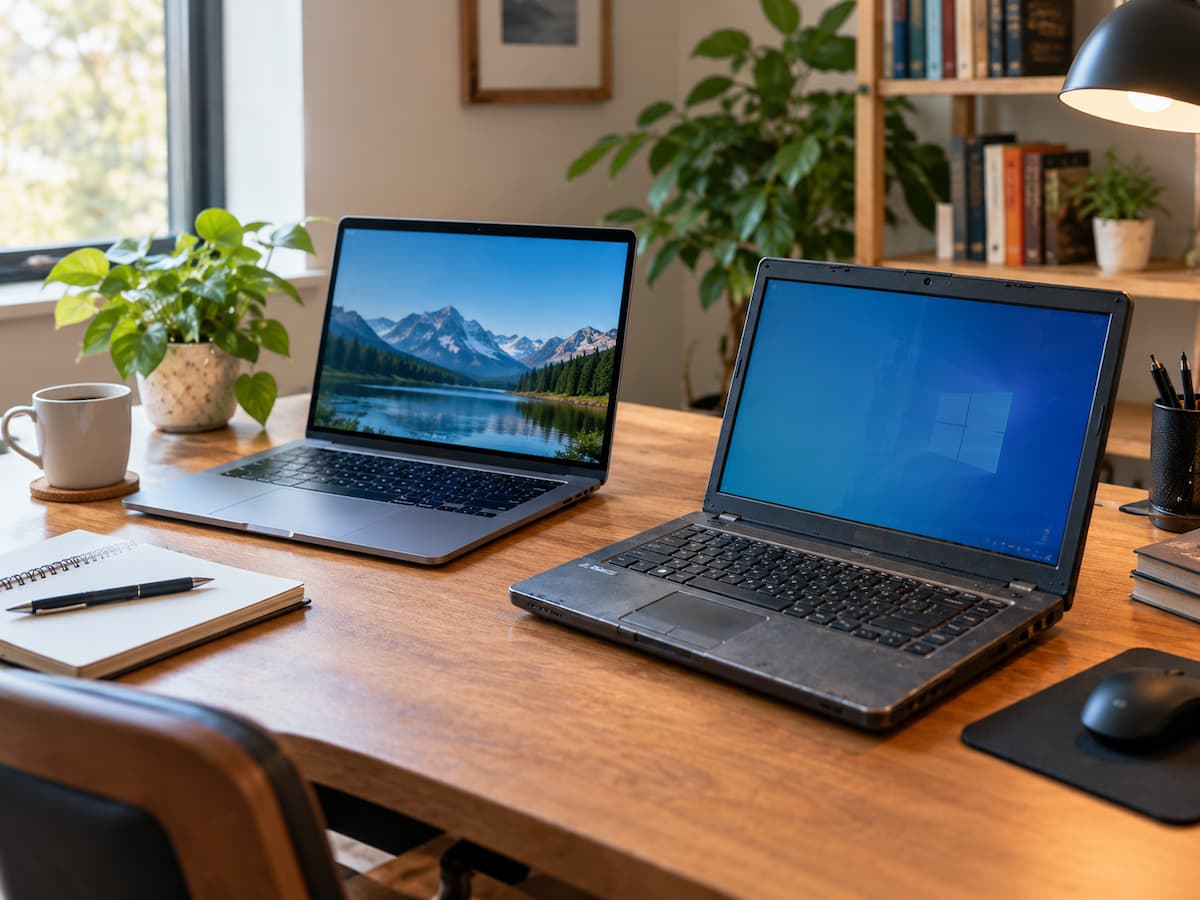
A second computer does not need to be powerful, modern, or expensive to be useful. In fact, one of the biggest mistakes people make with an older computer is judging it as if it were competing with their main machine. An ageing laptop may be too slow for demanding editing, gaming, or heavy multitasking, but that does not mean it has no practical purpose. Once a computer becomes a secondary device, the standard changes.
It no longer needs to handle everything. It only needs to handle a smaller set of jobs reliably. That can make an older computer surprisingly valuable. Instead of spending money on another brand-new machine, you may already have a device that can take care of specific tasks while your primary computer handles the demanding work.
Think of the Second Computer as a Tool, Not a Replacement
A primary computer usually has to do many things. It may be used for work, entertainment, communication, file management, creative applications, and dozens of smaller tasks throughout the day. A second computer does not have to carry that entire workload.
Its job can be much narrower. For example, an older laptop might become the computer you use for writing, reading, music, recipes, online courses, or simple administration. A desktop that is no longer powerful enough for modern workloads could still serve as a dedicated machine for documents, local files, or a particular older application. Such a shift changes how you evaluate it.
Instead of asking, “Is this computer still sufficiently capable enough to be my main computer?”
Ask: “What useful job can this computer still perform comfortably?”
That is often a much more favorable question.
Scenario 1: The Old Laptop Becomes a Writing Machine
Imagine an older laptop that struggles with demanding applications but handles a word processor and web browser without major problems. As a main computer, it may feel limited. As a dedicated writing machine, it could be perfectly adequate.
You could use it for drafting articles, taking notes, planning projects, reading documents, or working on text without filling your main computer with another set of applications and distractions. A smaller workload can also make an older computer feel faster simply because fewer things are competing for system resources. If the machine has a comfortable keyboard and a display you like, those qualities may matter more for writing than having the newest processor.
Scenario 2: A Second Screen for Information
An older computer can also become a useful information station. You might keep it beside your primary computer while working.
The second machine could display:
- Reference documents
- A calendar
- Research material
- Music
- Communication apps
- Project notes
- A timer
- Instructions or tutorials
This can reduce the need to constantly switch windows on the main computer. You are not asking the older system to perform complicated calculations. You are simply giving it a small supporting role. That can be enough to make it useful.
Scenario 3: A Dedicated Media Computer
An older computer may still be perfectly capable of handling basic media tasks. If it can comfortably play the video and audio formats you use, it might serve as a dedicated media device connected to a monitor, television, speakers, or another appropriate display.
This can be particularly practical if the computer already has the necessary ports and you do not need modern high-end features. The important consideration is what you actually want to play or access. Older hardware should not automatically be expected to handle every modern high-resolution format or demanding application.
Scenario 4: Keep Everyday Tasks Away From the Main Computer
Sometimes the value of a second computer comes from separation rather than performance. You may want one machine for demanding work and another for ordinary tasks. For example, the primary computer could remain focused on professional software while the older device handles browsing, email, shopping, reading, or personal administration.
This can make the primary computer easier to manage. It also means that a minor task does not require interrupting whatever you are doing on the main machine. The second computer becomes a buffer between different types of activity.
Scenario 5: A Computer for Learning
An older computer can be useful for learning because educational tasks often have modest hardware requirements. Writing code, practising basic office software, learning keyboard shortcuts, experimenting with a new operating system, or following tutorials may not require expensive hardware.
There is also an advantage to experimenting on a secondary machine. You may feel more comfortable changing settings, installing test software, reorganising the system, or trying a new workflow when the computer is not the one you rely on for important daily work. That does not remove the need for backups or sensible security practices, but it can make the learning process less stressful.
Scenario 6: A Backup Computer Can Be Worth More Than Its Performance
One of the most practical uses for an older computer is simply being available when the primary machine is unavailable. Computers fail at inconvenient times. A charging problem, broken display, failed drive, operating-system issue, or hardware repair can temporarily remove your main computer from service.
A secondary machine gives you another way to access essential files, accounts, communication tools, and basic work. It may not be as fast or comfortable, but it can prevent a complete interruption. That makes reliability more important than raw performance. A slow computer that starts every time can have more practical value as a backup than a powerful computer that is rarely available.
What Makes an Older Computer More Suitable for a Secondary Role?
Not every old computer is worth keeping. A useful second computer should meet a few basic conditions.
1. It Should Still Be Reliable
You do not want your backup computer to introduce another problem every time you need it. Occasional minor issues are one thing. Frequent crashes, failing storage, overheating, or charging problems are another matter.
2. It Should Have a Clear Purpose
A computer has limited value when it sits unused because you cannot decide what to do with it. Give it a defined job.
3. It Should Be Appropriate for the Software
An old computer can be useful for simple tasks while being unsuitable for modern applications. Check whether the software you intend to use is supported and whether the computer can run it comfortably.
4. It Should Not Require Constant Spending
If turning an old computer into a secondary machine requires several expensive repairs and upgrades, reconsider the economics. The whole point is to make use of existing hardware without creating an unnecessary project.
An Older Computer Can Be Better When the Job Is Simple
Modern computers are designed to handle a wide range of tasks. That flexibility is useful, but it is not always necessary. If a computer only needs to perform one or two simple jobs, its limitations become less important.
Consider this comparison:
| Main computer role | Possible second-computer role |
|---|---|
| Video editing | Script writing and research |
| Gaming | Web browsing |
| Professional work | Documents and email |
| Large creative projects | Reference material |
| Heavy multitasking | Single-purpose tasks |
| Main file management | Reading and notes |
The older computer does not need to match the primary computer.
It only needs to complement it.
Don’t Turn It Into a Money Pit
There is a temptation to upgrade an old computer until it becomes “adequate enough” enough”. That can work, but there is a point where the project stops making financial sense. Suppose an older laptop needs additional memory, a new battery, a replacement drive, and other repairs before it can serve as a second machine. At that point, calculate the complete cost.
| Expense | Question to ask |
|---|---|
| Storage upgrade | Is the existing storage actually a problem? |
| RAM | Does the intended workload need more memory? |
| Battery | Does the computer need to be portable? |
| Repairs | Are there existing hardware problems? |
| Accessories | Do you already have what it needs? |
| Software | Are the required applications supported? |
A small investment can be sensible.
A long list of upgrades deserves a more careful comparison with buying a newer used or entry-level computer.
A Second Computer Does Not Need to Be Portable
The phrase “second computer” often makes people consider another laptop. It does not have to be one. An older desktop can work well as a stationary secondary machine. If portability is irrelevant, its size may not matter much.
Likewise, an older laptop can remain permanently connected to power if its battery is no longer suitable for mobile use, provided doing so is appropriate for the device and its battery is in safe condition. The best secondary computer is the one that fits the job you have available.
Security Still Matters
Being a secondary computer does not make security unimportant. In fact, you should evaluate an old machine carefully before using it for internet-connected tasks. If the operating system no longer receives appropriate security updates, using it for sensitive accounts or important online activities may be a poor choice.
This is especially relevant for:
- Banking
- Password management
- Work accounts
- Sensitive documents
- Important personal information
A computer can be perfectly functional while no longer being appropriate for certain connected tasks. If the software environment is outdated, consider giving the machine an offline or limited role instead of assuming it is suitable for everything.
The Best Secondary Computer May Already Be in Your House
There is an interesting financial advantage to this approach. You do not necessarily have to buy another computer to have a second computer. If an older machine is already sitting in a drawer or closet and still works, it may be worth evaluating before spending money on another device.
You may discover that it is already capable of handling the one task you wanted a second machine for. That is especially useful when your need is occasional rather than constant. Buying a new computer for a task you perform twice a month is very different from buying one for something you do eight hours a day.
When an Old Computer Should Stay in Retirement
There is no requirement to find a job for every piece of ageing technology. Sometimes an old computer has simply reached the point where keeping it creates more inconvenience than value. Consider moving on when:
- It fails repeatedly.
- Important hardware is deteriorating.
- It cannot run the software needed for the intended task.
- It has serious battery or charging problems.
- It cannot maintain an appropriate security environment.
- Repairs cost more than the computer’s practical value.
- You have no realistic use for it.
Repurposing is useful only when the device can still perform the new role safely and reasonably.
A Simple Way to Choose Its New Role
If you have an old computer available, you might want to start with what you already do. Ask yourself:
What task do I wish my main computer did less often?
- Maybe it is browsing while you work.
- Maybe it is displaying research material.
- Maybe it is handling documents.
- It is serving as a backup.
- Maybe you simply want a separate machine for learning and experimentation.
- Once you identify that task, check whether the old computer can perform it.
This is much more effective than deciding on a role first and then trying to force the hardware to fit it.
The “Good Enough” Test
An old computer does not need to be impressive. It needs to be adequate enough for a specific purpose.
Try this simple test:
- Task: What exactly will the computer do?
- Frequency: How often will you use it?
- Performance: Does it complete the task without excessive waiting?
- Reliability: Can you depend on it?
- Support: Is the software environment appropriate?
- Cost: How much money would you need to spend before it becomes useful?
If the answers are favorable, there may be little reason to replace it.
Conclusion
It doesn’t have to replace your main computer, so you don’t have to buy a new second computer. An older system can be converted into a writing station, backup device, research screen, media computer, learning machine or a specific tool for simple tasks. It’s not about its age or specifications; it’s about the job it does and its value. The trick is to stop asking whether the old computer is powerful enough to compete with the modern technology. Ask what it can still do well. If the response is something stable, cheap and easy to maintain, then hanging on could be the smarter option.
FAQs
1. Is it worth maintaining an outdated computer as a second PC?
Yes, if it can do a certain job reliably while not needing expensive repairs or improvements. It can be a useful supplementary machine for an older computer that is no longer acceptable as a primary one.
2. What to do with an outdated computer?
Typical uses include writing, surfing, research, media playback, learning, seeing reference material, rudimentary office work and as a backup computer. It is contingent upon what hardware and software it can still support. What job is proper?
3. Is it necessary to upgrade an outdated computer before using it as a second computer?
Only if the upgrade fixes an obvious shortcoming. You may not wish to invest a significant amount of money in making an old computer function like a new one.
4. Is it safe for me to surf the Internet with an old computer?
Much depends on whether the operating system, browser, and other critical software continue to receive proper maintenance. Just because an unsupported system still functions doesn’t mean it should be assumed safe.
5. Do I have to maintain an old PC as a backup?
If the computer remains dependable and is able to execute the critical functions you would require should you have a problem with your primary computer, it can be a sensible choice. It doesn’t have to be powerful, simply there when it has to be.