
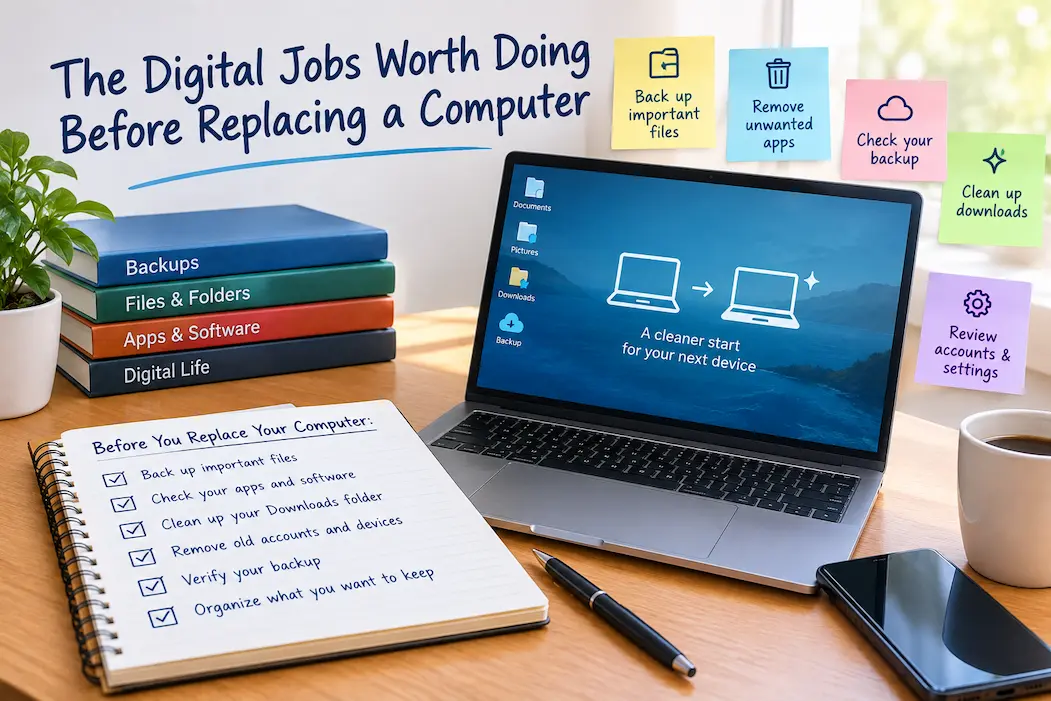
Replacing a computer is usually framed as a hardware decision: choose the new machine, move your files, and retire the old one. But the period before the replacement is actually one of the best times to deal with the digital work that has been postponed for months or years.
An old computer often contains more than useful files. It may hold forgotten downloads, outdated software, browser clutter, duplicate documents, old account connections, incomplete backups, and settings that no longer make sense. Moving all of that directly to a new machine can make the replacement feel like a fresh start while quietly carrying the old problems along with it.
You do not need to spend an entire weekend reorganizing your digital life before buying a new computer. A few targeted jobs can make the eventual transition considerably easier.
Start With The Information You Cannot Easily Replace
The first job is not deleting anything. It is identifying what would be difficult to recover if the old computer suddenly stopped working.
Think beyond your usual Documents and Pictures folders. Important information can be sitting on the desktop, inside Downloads, in project folders, within application-specific directories, or on an external drive that you have not checked recently. Old tax records, contracts, receipts, photographs, scans, work files, and personal projects are all worth considering before the hardware changes.
A useful test is to ask yourself whether you could obtain the item again if the computer failed tomorrow. If the answer is no, it deserves attention before anything else. The Digital Cleanup Checklist can help you work through the main areas without turning the process into an attempt to inspect every file on the computer.
Look Beyond The Obvious Folders
The folders you use every day are usually not the problem. Forgotten material tends to accumulate in places that were convenient at the time but never became part of a proper filing system.
Check the desktop, Downloads, old project folders, exported files, scanned documents, and folders created by software you no longer use. You may not need to move everything to the new computer, but you should know what is there before deciding what can safely be left behind.
This is particularly important for Downloads. A folder that looks like temporary storage may contain years of receipts, invoices, photographs, forms, and other documents mixed with files that have no remaining value.
Verify Your Backup Before The Hardware Changes
A computer replacement is a poor time to discover that your backup system was not working as expected.
If your important files are stored in cloud storage, open the service and check several older files. If you use an external drive, connect it and confirm that the backup is accessible. Do not rely solely on a synchronization icon or a message saying that everything is up to date.
The verification does not have to become a technical audit. Open a few different types of files and confirm that they are actually available where you expect them to be. An older photograph, an important document, a spreadsheet, and a file that would be particularly difficult to recreate are enough to reveal obvious problems.
If the backup contains only a portion of what you thought it contained, you still have the old computer available to correct the situation.
Clean Up Downloads Before They Become New-Computer Clutter
A new computer creates a temptation to simply copy the entire Downloads folder and deal with it later. That usually means “later” never arrives.
Instead, separate the files that have a reason to survive from those that were temporary. Installation files for programs you can download again, duplicate attachments, obsolete documents, and files you no longer recognize may not need to move. Important receipts, records, work documents, and personal files deserve a different treatment.
The Downloads Folder Audit Worksheet is particularly useful here because it encourages you to decide what each file is for rather than deleting things based only on age or filename.
The objective is not to make the old computer perfectly organized. It is to prevent a temporary folder from becoming part of your new permanent storage system.
Review The Software You Actually Use
A computer that has been used for several years can accumulate a surprising number of applications. Some were installed for a single project, some were tested once, and others may have been replaced by better tools.
Before replacing the computer, look through your installed applications and divide them mentally into three groups: used regularly, occasionally useful, and no longer needed.
The first group should be easy to identify. The second group may require a little thought. The third group can usually stay behind. There is little advantage in moving years of unused software simply because it happens to be installed.
This review is also a chance to notice applications that contain information you need to preserve. Removing an application is not the same as removing its data, and reinstalling a program on the new computer may not restore locally stored projects or archives.
Check Important Application Data Separately
Programs that hold personal or work information deserve more attention than ordinary utilities.
Think about accounting software, email applications with local archives, project-management tools, design programs, note-taking applications, recording software, photo-management programs, or anything else where you created information inside the application itself.
Find out whether that information is synchronized, backed up, exported, or stored locally. If you are uncertain, do not assume the data will appear automatically on the new machine.
The application can often be downloaded again. Your locally stored work may not be so easy to recreate.
Decide Whether Your Filing System Still Makes Sense
Moving to a new computer is one of the few natural opportunities to reconsider how your files are arranged.
If you regularly search for documents because you cannot remember where you put them, copying the old folder structure exactly may simply move the problem. You do not need an elaborate hierarchy of folders. A small number of logical locations that match the way you actually retrieve information is usually easier to maintain.
Consider separating active documents from older records, giving important receipts and warranties a predictable location, and keeping current projects distinct from completed work. The structure should make sense six months from now, not just on the day you create it.
The Personal Digital Filing System Worksheet can help you design that structure before you start moving files to the replacement computer.
Review Your Photos and Determine Which Ones Are the Originals
You don’t need to organize all your photos before buying a new computer, but you do need to know where the important originals are located.
Check whether your photos are stored in the cloud, on your computer, on a hard drive, or elsewhere. Pay attention to old photos, videos, screenshots, scans, and images you may have added manually.
Don’t rush into mass deletions at this stage. The goal right now is preservation, not perfection. Once you have created a secure backup, you can delete any duplicates or unwanted photos from your collection.
This is important because, while cleaning up your photo library and preparing for a new computer are related tasks, they don’t have to be done at the same time.
Double-Check Everything Before Reinstalling Your Browser
When getting a new computer, it is easy to overlook information that has been stored in your browser for years.
Check your browser profiles, reading lists, bookmarks, saved passwords, and the applications you actually use. If synchronization is enabled, ensure you are using the correct account and can access important files without needing your old computer.
However, you don’t need to copy over every single old browser setting. A new computer can feel overwhelming if you carry over hundreds of forgotten tabs and applications.
Keep the information relevant to your current work and habits, and clear out digital clutter you no longer use.
Verify That Your Account Recovery Options Are Still Working
A new computer can expose account recovery vulnerabilities that have existed for years but gone unnoticed. Check your most important accounts and ensure you know how to access them on your new computer. Pay special attention to your primary email account, as it is often linked to other services used for resetting passwords or recovering data.
Review your security devices or passwords, password managers, login methods, recovery options, and any other methods used to protect your data. You don’t need to list every single account, but be aware of those where losing access could have serious consequences.
Be careful not to wipe your old computer only to discover later that it was the only machine capable of handling certain login processes.
Record The Details You Will Need To Rebuild Your Setup
If you want to start fresh rather than cloning your old computer, you should list your key software and settings.
Note down the names of important programs, required login credentials, any special hardware or workarounds, and any plug-ins or extensions they use. Ensure you know which account is associated with programs requiring a license or subscription.
This doesn’t need to be a technical manual; after all, you don’t want to discover three weeks after buying your new computer that you no longer know how to configure a specific application. A simple list will suffice.
For professional use, it is also advisable to keep track of connected devices that may require specific software or drivers, such as scanners, drawing tablets, printers, audio equipment, or other peripherals.
Decide What The Old Computer Is Going To Become
Before replacing the computer, decide what will happen to the old one.
If you are keeping it as a backup, your preparation will be different from a computer that will be sold, donated, returned, or handed to someone else. The latter requires more attention to account removal and data erasure.
If the computer is going to another person, do not leave this decision until the day the new machine arrives. Knowing the intended destination helps you understand how carefully you need to prepare the old device and what information must be removed.
The Old Device Evaluation Checklist can help you decide whether the old machine is worth keeping, repairing, repurposing, selling, donating, or recycling.
A Small Pre-Replacement Audit Can Save A Lot Of Trouble
You do not need to complete dozens of digital housekeeping tasks before buying a replacement. The most valuable work is the work that prevents avoidable problems.
| Job | What To Check | Priority |
|---|---|---|
| Important files | Personal documents, photographs, projects and records | High |
| Backup | Confirm important files are actually accessible elsewhere | High |
| Downloads | Separate useful files from temporary clutter | High |
| Application data | Check software that stores information locally | High |
| Accounts | Confirm access and recovery methods | High |
| Browser | Preserve important bookmarks and credentials | Medium |
| Photos | Verify important originals and older material | High |
| Software | Identify applications you genuinely still use | Medium |
| Filing system | Decide whether the old structure should be improved | Medium |
| Old computer | Decide whether it will be kept or transferred | High |
The table is deliberately shorter than a complete migration checklist because these are the jobs that are most useful before the hardware changes. Once the new computer arrives, there will be a separate set of tasks for moving data, installing software, testing the setup, and deciding when the old machine can finally be reset.
Don’t Turn Preparation Into Another Cleanup Project
Sometimes, preparation becomes an excuse to procrastinate. You don’t need to organize all your photos, rename every document, or delete every unnecessary program before getting a new computer.
Pay attention to choices that are difficult to reverse. Keep important information safe. Check your backups. Identify program data that requires special handling. Ensure you have access to important accounts. Decide which files to transfer to the new computer and which ones to leave behind.
For everything else, you can take it easy.
In fact, trying to clean up your old computer before getting a new one can lead to unnecessary extra work. A better goal is to ensure the safety of important files and make sure the new computer doesn’t create new usability issues.
The Best Preparation Makes The New Computer Easier To Build
Getting a new computer is a great opportunity to make changes, as it allows you to rethink the habits you’ve developed over the years. You can choose to transfer only important files rather than every old folder. You can also opt to reinstall only your most frequently used programs instead of all of them, making it easier to keep the system up to date.
“Cleaning up the old computer” isn’t the main priority; deciding what to keep is.
Once you’ve made that decision, finding a replacement computer becomes much simpler. You’ll know what needs backing up, what requires special attention, what can be discarded, and how to rebuild the system. With a new computer, the goal is no longer to create a perfect replica of the old one, but to build a system that meets your current needs while preserving the old files you still require.
Frequently Asked Questions
Do I need to clean up my entire computer before buying a new one?
Absolutely not. A thorough cleanup isn’t necessary every time you buy a new computer. Focus first on clearing out important files—especially those that are hard to recover—as well as copies, accounts, and other content. Don’t put off buying a new computer just to clean up less important files; you can deal with those later.
Do I need to buy a new computer and transfer all my applications?
You often don’t need to transfer every program you have installed. Look at the applications you actually use, then restore the ones that are useful for your current work and tasks. Be extra careful with programs that rely on local storage data, as that data may need to be backed up or exported separately.
What should I do with my old Downloads folder?
Review it before moving anything. Keep files that are important or difficult to replace, while temporary downloads and obsolete installation files can usually be left behind. If you have a large Downloads folder, the Downloads Folder Audit Worksheet provides a structured way to review it.
Should I start fresh or copy my old computer exactly?
It depends on the condition of your existing setup. If the old computer is stable and well organized, preserving more of it may save time. If it contains years of unused software, clutter, or configuration problems, starting fresh or using a hybrid approach can produce a cleaner result. In either case, your important personal information should be preserved separately from the old computer environment.
What is the most important thing to do before replacing a computer?
Verify that the information you cannot easily replace exists somewhere you can actually access. That means checking important files, photographs, application data, and account access rather than simply trusting that a backup or synchronization service has handled everything. Once those areas are secure, the remaining preparation becomes much easier.