
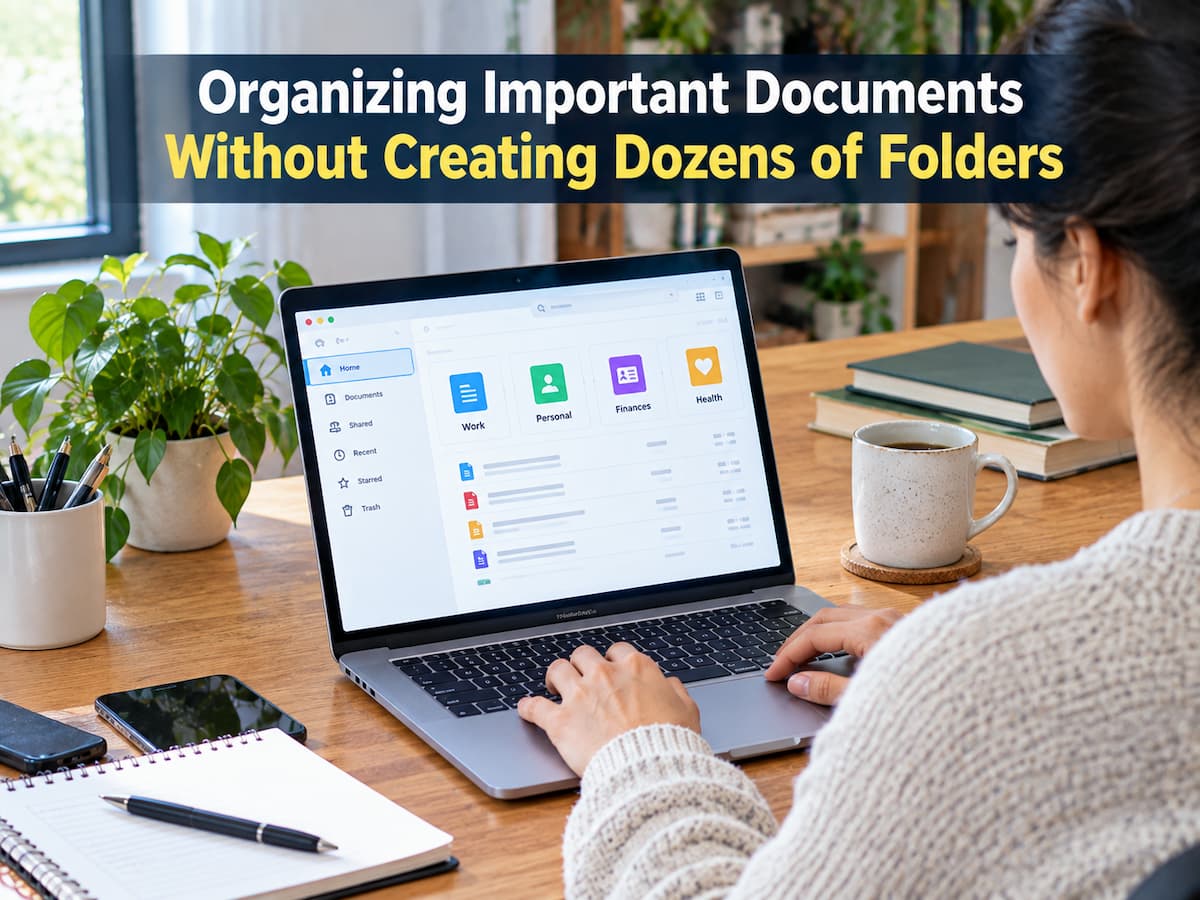
Important documents have a strange way of multiplying. One bank statement becomes twelve. A home purchase creates contracts, receipts, warranties, and inspection reports. Insurance adds another collection of PDFs, while tax records, medical paperwork, school documents, identification records, and household information continue to arrive throughout the year. Before long, a computer can contain hundreds of files spread across folders with names that seemed sensible when they were created.
The natural reaction is to create more folders. That usually feels productive at first. You make a folder for every type of document, then another folder inside it for years, another for individual accounts, and perhaps another for each person in the household. The result looks organised, but finding one document can become surprisingly difficult.
A better filing system does not try to give every document its own little box. It creates a small number of meaningful places and uses filenames, dates, and search tools to handle the finer details.
The Goal Is Retrieval, Not a Perfect Folder Tree
The purpose of organising documents is simple: you should be able to find something when you need it.
A folder structure can look impressive while still failing this basic test. Imagine opening a folder and seeing:
Documents > Finance > Banking > Personal > 2025 > Main Account > Statements > January
That may be appropriate for a very specific archive, but it is a lot of navigation for a document you may only need once or twice.
Compare that with:
Documents > Financial Records > 2025 > Bank Statement - January
The second system gives you fewer decisions. The filename carries some of the information that would otherwise require another layer of folders.
This leads to a useful principle:
Use folders for broad categories and filenames for details.
Once you start thinking this way, you no longer need to build a separate folder for every possible document type.
A Small Number of Categories Can Handle Most Documents
Most households do not need twenty or thirty top-level document folders. A small collection of broad categories can cover a surprisingly large amount of information.
| Main Category | Examples of Documents |
|---|---|
| Financial | Bank statements, loan records, investment documents, tax paperwork |
| Home & Property | Lease, mortgage papers, repairs, warranties, utility records |
| Insurance | Home, car, travel, life, and other policy documents |
| Personal | Identification copies, certificates, education records |
| Work | Employment documents, contracts, payslips, professional records |
| Vehicle | Registration, service records, insurance-related documents |
| Archive | Older documents that are rarely needed |
The exact categories can be changed to suit your situation. The important part is keeping them broad enough that you are not constantly asking yourself where a document belongs.
For example, there is little benefit in creating separate folders called Car Insurance, ‘andTravel Insurance if you only have a handful of files in each’. A single Insurance folder can handle all three.
Think in Terms of Document Families
A useful way to reduce folder clutter is to group documents according to the thing they belong to rather than every possible subject.
A home, for example, can generate a surprising number of records. Instead of creating separate top-level folders for property taxes, repairs, appliance warranties, contractor invoices, and utility documents, you might keep them under a broader Home & Property category.
The same idea works for finances.
Instead of creating separate folders for:
- Credit card statements
- Bank statements
- Loan statements
- Tax documents
- Investment statements
- Payment confirmations
You could keep broad financial records together and use clear filenames to distinguish them.
This approach works because the folder answers the broad question—“What part of my life does this belong to?”—while the filename answers the more specific question—“What exactly is this?”
Give Each Folder a Job
A folder becomes easier to manage when you can explain its purpose in one sentence.
For example:
Financial Records: Documents related to personal finances and taxes.
Home & Property: Documents connected to the home, rental property, repairs, and major household purchases.
Insurance: Current and historical insurance policies and related correspondence.
Personal Records: Important personal documents that do not naturally belong elsewhere.
If you cannot explain why a folder exists, that is often a sign that it may not deserve to exist.
This does not mean every folder must be extremely broad. Some documents genuinely benefit from their own space. The point is to create folders because they solve a retrieval problem, not because creating another folder feels like organising.
Use Subfolders Only When They Remove Confusion
Subfolders are not bad. The problem is using them automatically.
A broad category can remain a single folder until the number of documents makes it difficult to navigate. At that point, one simple subdivision can make sense.
For example:
Financial Records
→ 2024
→ 2025
→ 2026
Or:
Home & Property
→ Current Home
→ Previous Home
Or:
Insurance
→ Current Policies
→ Previous Policies
Notice what is missing: multiple layers of increasingly specific folders.
A good rule is to stop adding levels when the folder already gives you enough information to locate the document quickly.
Let Filenames Carry Some of the Organisational Load
Filenames are often treated as an afterthought, but they can prevent unnecessary folders.
A file named:
document.pdf
is almost useless.
A file named:
2026-08 Bank Statement Checking Account.pdf
already tells you several things before you open it.
A useful filename generally includes the information you are most likely to remember when searching later. Depending on the document, that might include the date, organisation, document type, account, property, or subject.
Here are a few examples:
| Weak Filename | More Useful Filename |
|---|---|
scan001.pdf |
2026-04-15 Home Insurance Policy.pdf |
receipt.pdf |
2026-05 Laptop Purchase Receipt.pdf |
letter.pdf |
2026-02 Tax Office Notice.pdf |
statement.pdf |
2026-06 Credit Card Statement.pdf |
warranty.pdf |
2026 Refrigerator Warranty.pdf |
You do not need to make filenames excessively long. The goal is recognition, not documentation.
Dates Are Especially Helpful for Records That Repeat
Many important documents look almost identical from one month or year to another. Bank statements, invoices, insurance documents, tax records, utility bills, and employment records are good examples.
Adding a consistent date makes those files much easier to sort and search.
A simple format such as
YYYY-MM-DD
has an additional advantage: files naturally sort in chronological order when the date appears at the beginning.
For documents where the exact day is not important, you can use:
YYYY-MM
For example:
2026-01 Electricity Bill.pdf
2026-02 Electricity Bill.pdf
2026-03 Electricity Bill.pdf
This is much easier to scan than a folder containing twenty files all beginning with “Electricity Bill”.
Do Not Create a New Folder for Every Year Too Early
Year-based folders can be useful, but they are not automatically necessary.
If you have six important financial documents from one year, putting each type into a separate yearly folder may create more navigation than it removes.
Instead, consider keeping several years together until the collection becomes large enough to justify splitting it.
For example:
Financial Records
2024-01 Bank Statement.pdf
2024-06 Tax Notice.pdf
2025-03 Bank Statement.pdf
2025-11 Tax Record.pdf
2026-01 Bank Statement.pdf
Once the collection becomes difficult to scan, then you can introduce year folders.
Organisations should respond to actual volume rather than anticipated volume.
Create a “Current” Area for Documents You Still Use
Some documents are important because they are frequently referenced, not because they are old records.
Current insurance policies, active leases, current warranties, recent contracts, and documents related to ongoing projects should not necessarily be buried inside a deep archive.
A simple Current folder can make these files easier to reach.
For example:
Insurance
- Current
- Archive
Home & Property
- Current
- Archive
This arrangement is especially useful when an old document needs to be retained but does not deserve to compete for attention with something you currently use.
An Archive Is Better Than Endless Sorting
There is often a point where old documents stop being part of everyday life but still need to be retained.
That is where an archive becomes useful.
Instead of repeatedly deciding whether every old file deserves its own location, move completed or inactive material into a broader archive structure.
For example:
Archive
→ 2024
→ 2025
→ Previous Home
→ Previous Vehicle
The archive does not need the same level of organisation as active documents. You visit it less often, so it can be simpler.
The mistake is allowing the archive to become a dumping ground for everything. Files should still have understandable names, and obviously unnecessary duplicates can be removed when you are confident they have no future value.
What Belongs Together and What Should Stay Separate?
Not every document needs to be grouped according to the same logic. Some are naturally connected by subject, while others are connected by time or purpose.
| Document Type | Useful Organising Method |
|---|---|
| Bank statements | Institution + date |
| Insurance policies | Policy type + current/archive |
| Home records | Property + document type |
| Tax documents | Tax year |
| Vehicle records | Vehicle + date |
| Warranties | Product + purchase date |
| Employment records | Employer + year |
| Personal certificates | Document type |
| Receipts | Purchase/item + date |
The table illustrates an important point: there is no single filing rule that has to apply to every category.
A tax record may be easiest to find by year. A warranty may be easier to find by product. A vehicle document may make more sense under the specific vehicle.
Good organisation allows these differences instead of forcing everything into one rigid structure.
Avoid the “Miscellaneous” Trap
A folder called Miscellaneous ‘Feels Harmless’.
It often becomes the place where every difficult decision goes. Six months later, it contains insurance letters, appliance manuals, tax notices, receipts, screenshots, old contracts, and files whose purpose you can barely remember.
A miscellaneous folder can be useful as a temporary holding area, but it should not become the permanent home for important documents. If you repeatedly put the same type of file into it, that is useful information. It probably deserves a proper category.
Search Should Be Part of the Filing System
Modern computers make it unnecessary to depend entirely on folders. If your filenames contain useful words, system search can become a second layer of organisation. Suppose you remember that you need a document from an insurance company but cannot remember whether you saved it under Home, or.
Searching the company name may locate it immediately. This is another reason not to overbuild folders. Your system does not have to answer every question through navigation. Sometimes the fastest route is simply searching for the right word. The combination of broad folders and searchable filenames is often more powerful than a deeply nested folder structure.
A Simple Test for Every New Folder
Before creating another folder, ask yourself three questions:
- Will this folder contain enough files to justify itself?
- Will it make future searching faster?
- Could the same information be handled with a better filename?
If the answer to all three is no, you probably do not need the folder.
This small pause can prevent an organised system from gradually turning into a maze.
What a Practical Document System Might Look Like
For someone starting from scratch, a relatively simple structure could look like this:
Documents
│
├── Financial Records
│   ├── 2025
│   └── 2026
│
├── Home & Property
│   ├── Current
│   └── Archive
│
├── Insurance
│   ├── Current
│   └── Archive
│
├── Personal Records
│
├── Work
│
└── Archive
That is enough structure for many people.
It can then grow naturally. If the Work folder becomes large, it can develop a structure that fits the person’s job. If Home & Property contains too many files, a few sensible subfolders can be added.
The system should evolve because the files require it—not because a complicated structure looks more professional.
The Easiest Way to Clean Up an Existing Mess
If your current Documents folder is already chaotic, do not try to perfect everything in one sitting.
Start by creating the broad categories. Then move obvious files into the appropriate areas. Do not stop every few minutes to decide the perfect filename for an old receipt or determine whether a document belongs in one of two nearly identical folders.
The first goal is separation. Once the broad structure exists, you can gradually improve filenames and manage duplicates. This prevents the cleanup itself from becoming an exhausting organisational project.
A useful sequence is:
Separate → Rename → Archive → Review
Separating files gives them a home. Renaming makes them identifiable. Archiving removes older material from active areas. Reviewing allows you to deal with duplicates or genuinely unnecessary documents later.
The System Should Still Work Six Months From Now
The real test of a filing system is not how satisfying it feels on the day you create it. The better question is what happens six months later.
- Will you remember what the folders mean?
- Can you save a new document without creating another category?
- Can you find an old document without opening ten folders?
- Can someone else understand the basic structure if they ever need to locate something?
If the answer is yes, the system is doing its job. The organisation does not need to eliminate every bit of digital mess. Important documents simply need clear enough homes that they do not disappear into the mess.
Conclusion
A well-organised document system isn’t about having as many folders as possible; it’s about providing the right cues when you need them. Broad categories keep the structure clear and uncluttered, descriptive filenames provide details, dates distinguish between duplicate documents, and separate folders for current and archived items prevent old documents from piling up. Search functions help you quickly locate documents when you can’t remember their exact location. Ultimately, you end up with a filing system that doesn’t require constant maintenance. Instead of spending time deciding which specific subfolder a document belongs in, you assign it a designated spot and move on to the next one. The fewer unnecessary decisions the system requires, the more likely you are to keep using it.
FAQs
1. How many main folders should I have for important documents?
There is no fixed maximum, but generally, it is easier to start with five to seven broad categories than with dozens of separate folders. Only add new categories if you actually encounter difficulties retrieving documents.
2. Should I sort documents by type or by year?
That depends on the specific document. Recurring documents, such as tax records and reports, are best organised by year, whereas warranty documents and proofs of ownership are easier to locate by product or subject. Using a combination of methods is perfectly fine.
3. Should you create a folder for every type of document?
Generally, no. Too many folders increase the decisions you have to make and make it harder to find files. Using broad categories combined with descriptive filenames is usually more practical.
4. Should old documents be discarded?
Only delete them if you are certain they are no longer needed and there is no legal, financial, contractual, or practical reason to retain them. If in doubt, consider whether you might need the document later before deleting it.
5. Should important documents be stored in the cloud?
Cloud storage offers convenient access and added protection, but it should not be considered the sole backup strategy. Important documents must be properly backed up and recoverable.